



Question: Consider the following hypothesis test. Ho: d = 100 Hill * 100 A sample of 65 is used. Identify the p-value and state your conclusion
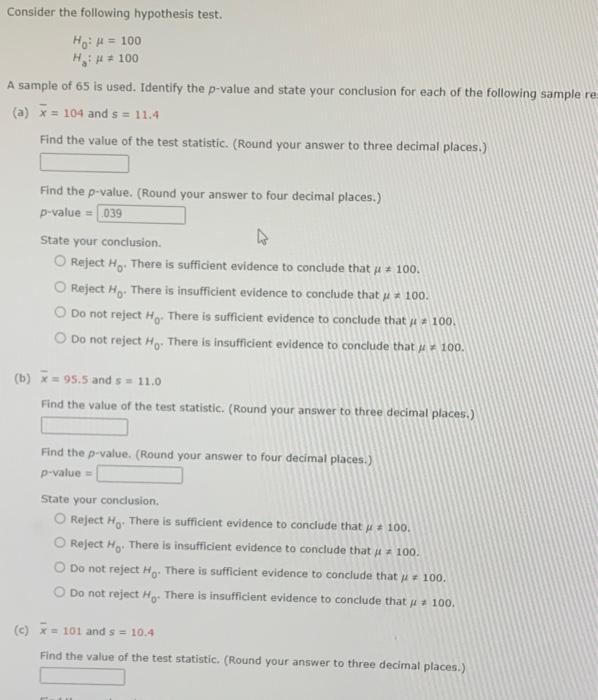
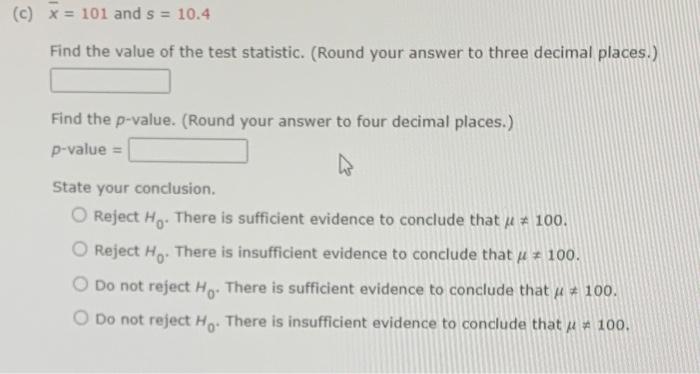
Consider the following hypothesis test. Ho: d = 100 Hill * 100 A sample of 65 is used. Identify the p-value and state your conclusion for each of the following sample re- (a) * = 104 and s = 11.4 Find the value of the test statistic. (Round your answer to three decimal places.) Find the p-value. (Round your answer to four decimal places.) p-value = 039 State your conclusion. Reject Ho. There is sufficient evidence to conclude that + 100. O Reject Hy. There is insufficient evidence to conclude that j = 100. Do not reject Hy. There is sufficient evidence to conclude that j = 100. Do not reject Hy. There is insufficient evidence to conclude that u + 100. (b) 2 = 95.5 and s = 11,0 Find the value of the test statistic. (Round your answer to three decimal places.) Find the p-value. (Round your answer to four decimal places.) p-value = State your conclusion O Reject Ho. There is sufficient evidence to conclude that + 100. Reject Hy. There is insufficient evidence to conclude that 4 2 100. Do not reject Ho. There is sufficient evidence to conclude that ju * 100. Do not reject Hg. There is insufficient evidence to conclude that u + 100. (c) 7 = 101 and s = 10.4 Find the value of the test statistic. (Round your answer to three decimal places.) (C) * = 101 and s = 10.4 Find the value of the test statistic. (Round your answer to three decimal places.) Find the p-value. (Round your answer to four decimal places.) p-value = State your conclusion. O Reject Ho. There is sufficient evidence to conclude that u * 100. Reject Ho. There is insufficient evidence to conclude that u + 100. Do not reject Ho. There is sufficient evidence to conclude that y* 100. O Do not reject Ho. There is insufficient evidence to conclude that ju * 100
Step by Step Solution
There are 3 Steps involved in it

Get step-by-step solutions from verified subject matter experts