





Question: Consider the following linear program: Max Z = 2x1 + x2 + 3x3 s. t. X1 + 4x2 + 4x3 = 20 4x1 + 4x2
Consider the following linear program: Max Z =

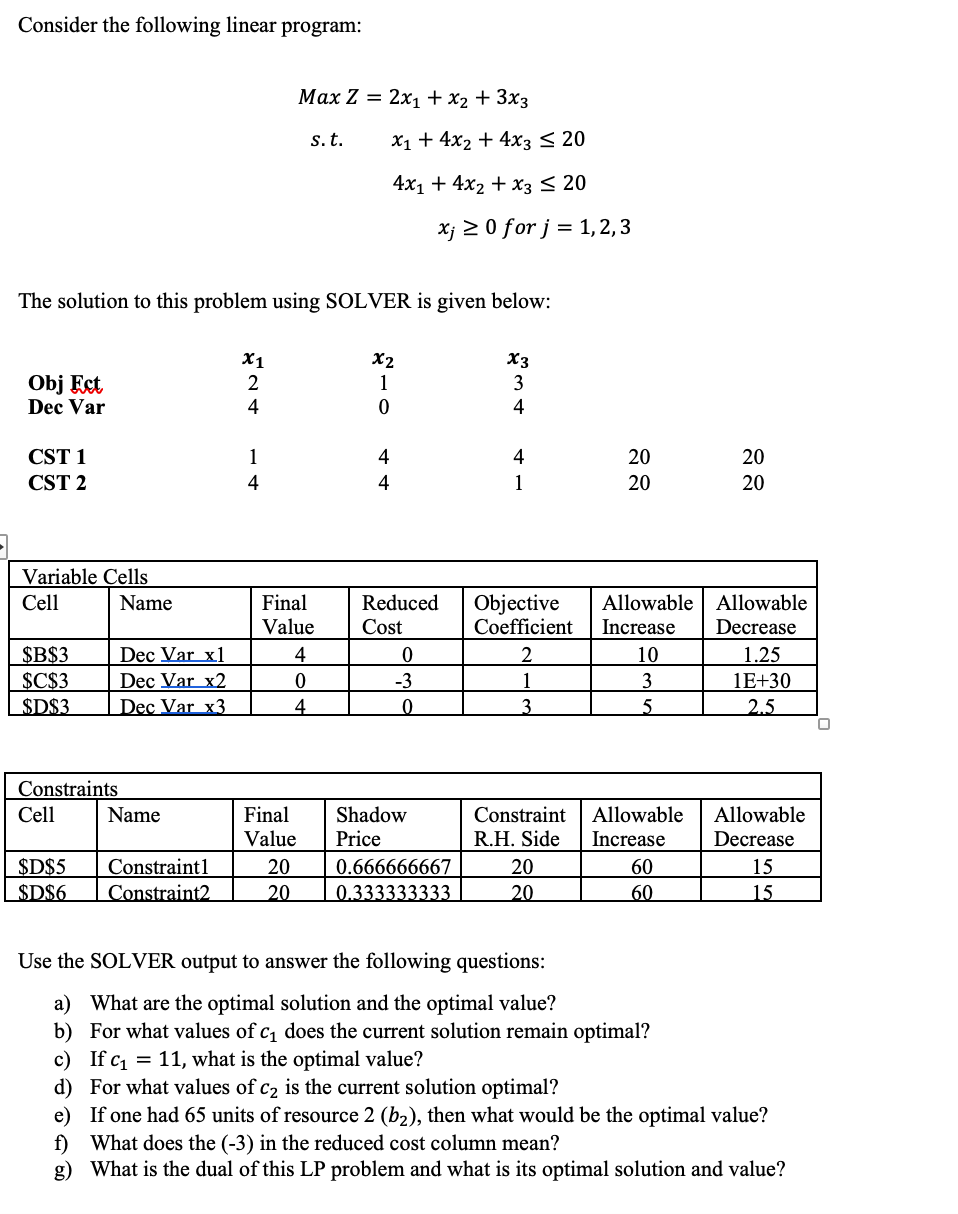
Consider the following linear program: Max Z = 2x1 + x2 + 3x3 s. t. X1 + 4x2 + 4x3 = 20 4x1 + 4x2 + x3 = 20 X; 2 0 for j = 1,2,3 The solution to this problem using SOLVER is given below: Obj Ect Dec Var X1 2 4 X2 1 0 X3 3 4 CST 1 CST 2 1 4 4 4 4 1 20 20 20 20 Variable Cells Cell Name $B$3 $C$3 $D$3 Dec Var x1 Dec Var x2 Dec Var x3 Final Value 4 0 4 Reduced Cost 0 -3 0 Objective Coefficient 2 1 3 Allowable Allowable Increase Decrease 10 1.25 3 1E+30 5 2.5 Constraints Cell Name Final Value 20 20 Shadow Price 0.666666667 0.333333333 Constraint R.H. Side 20 20 Allowable Increase 60 60 Allowable Decrease 15 15 $D$5 $D$6 Constraint1 Constraint2 Use the SOLVER output to answer the following questions: a) What are the optimal solution and the optimal value? b) For what values of c does the current solution remain optimal? c) If C1 = 11, what is the optimal value? d) For what values of c2 is the current solution optimal? e) If one had 65 units of resource 2 (bz), then what would be the optimal value? f) What does the (-3) in the reduced cost column mean? g) What is the dual of this LP problem and what is its optimal solution and value

Step by Step Solution

There are 3 Steps involved in it

1 Expert Approved Answer
Step: 1 Unlock blur-text-image

Question Has Been Solved by an Expert!

Get step-by-step solutions from verified subject matter experts

Step: 2 Unlock
Step: 3 Unlock

Students Have Also Explored These Related General Management Questions!