







Question: Consider the following LP max = 51 + 32 + 3 .. 21 + 2 + 3 6 1 + 22 + 3 7 1
Consider the following LP max = 51 + 32 + 3 .. 21 + 2 + 3 6 1 + 22 + 3 7 1 , 2 , 3 0 1) Solve the problem with Simplex algorithm. (10 points) 2) What is the dual of this LP? (5 points) 1 - number of desks produced 2 - number of tables produced 3 - number of chairs produced Max = 601 + 302 + 203 s.t. 81 + 62 + 3 48 Lumber constraint 41 + 22 + 1.53 20 Finishing hour constraint 21 + 1.52 + 0.53 8 Carpentry hour constraint 1 , 2 , 3 0 3) Using complementary slackness to determine the basic variables of the dual problem. (2 points) 4) Which constraints are binding in the dual? (3 points) 5) What is the optimal solution of the dual problem? (5 points) 6) What are the shadow prices and reduced costs of the primal problem? (10 points)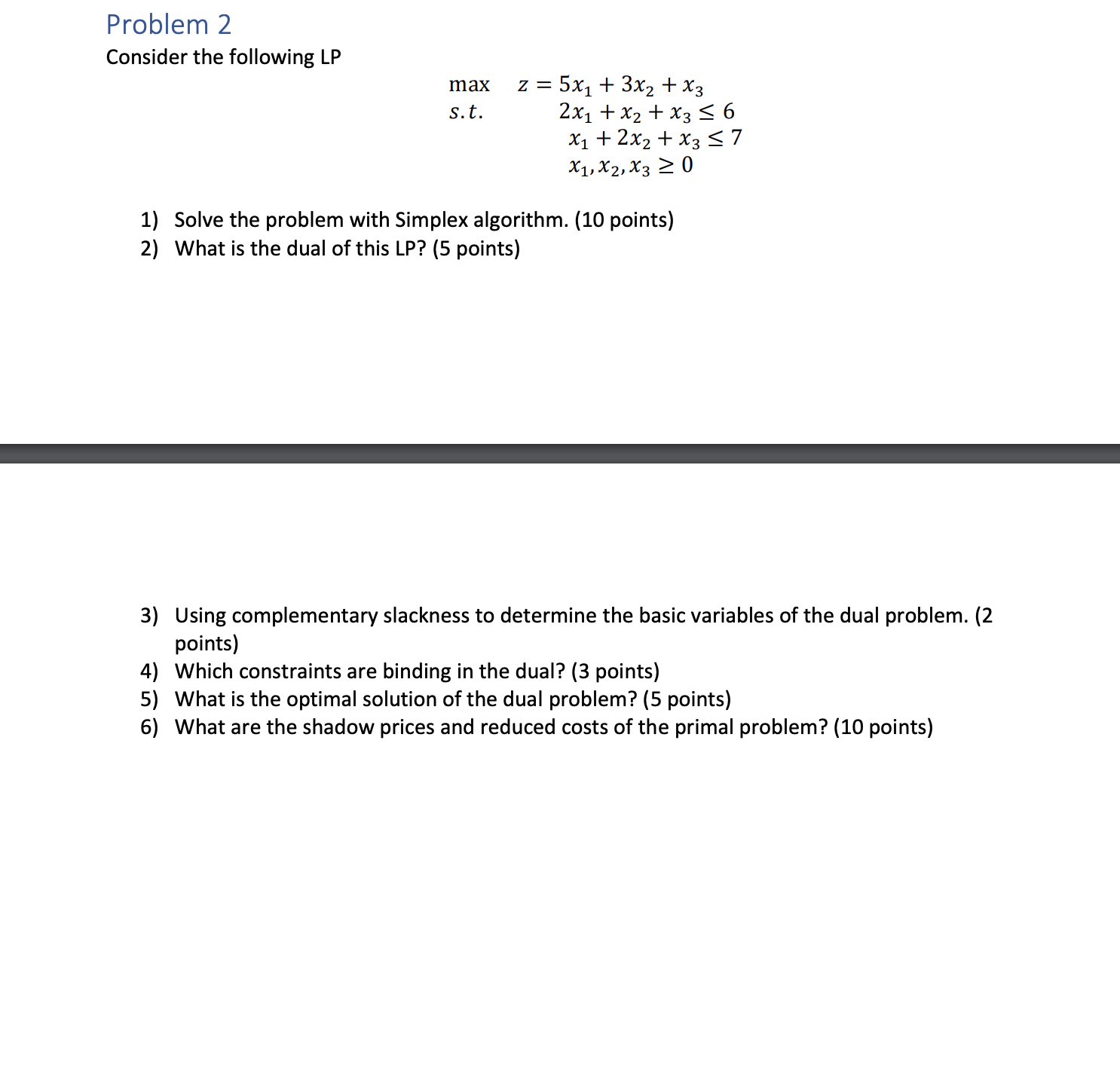
Problem 2 Consider the following LP maxs.t.z=5x1+3x2+x32x1+x2+x36x1+2x2+x37x1,x2,x30 1) Solve the problem with Simplex algorithm. (10 points) 2) What is the dual of this LP? (5 points) 3) Using complementary slackness to determine the basic variables of the dual problem. (2 points) 4) Which constraints are binding in the dual? (3 points) 5) What is the optimal solution of the dual problem? (5 points) 6) What are the shadow prices and reduced costs of the primal problem? (10 points)
Step by Step Solution
There are 3 Steps involved in it

Get step-by-step solutions from verified subject matter experts
 Study Help