







Question: This is a practice from a book. However, it includes more questions than solving a big M method. Could you help me and share your
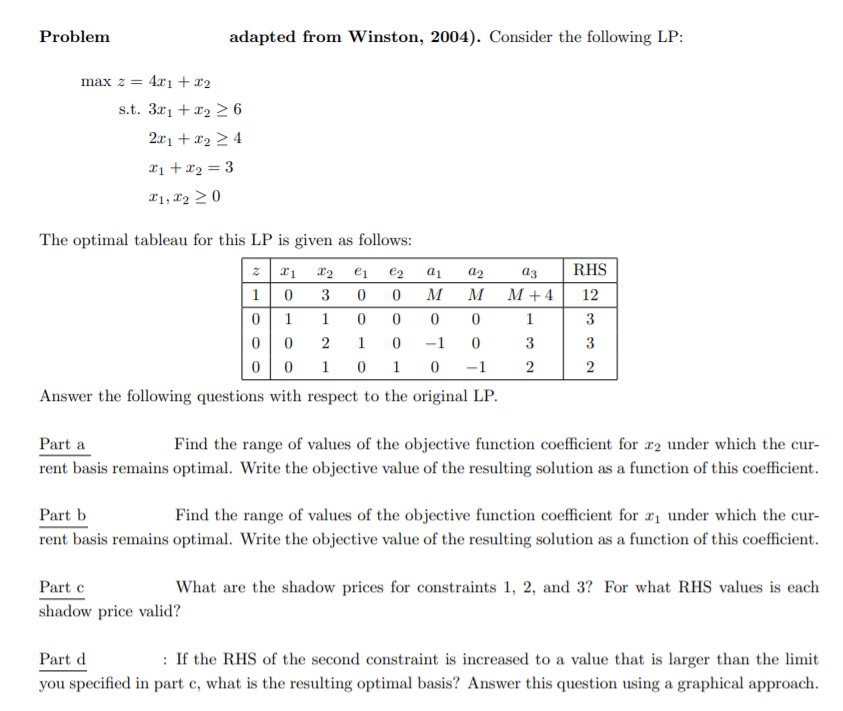
This is a practice from a book. However, it includes more questions than solving a big M method. Could you help me and share your ideas/knowledge? Thanks
Problem adapted from Winston, 2004). Consider the following LP: max 2 = 4.11 +.22 s.t. 3.11 + 12 > 6 221 +22 > 4 11 + 12 = 3 21,22 > 0 The optimal tableau for this LP is given as follows: 221 22 ene2 a 1 0 3 0 0 M 0 1 1 0 0 0 0 0 2 1 0 -1 0 0 1 0 1 0 RHS 12 02 M 0 0 -1 03 M +4 1 3 2 Answer the following questions with respect to the original LP. Part a Find the range of values of the objective function coefficient for 12 under which the cur- rent basis remains optimal. Write the objective value of the resulting solution as a function of this coefficient. Part b Find the range of values of the objective function coefficient for 2 under which the cur- rent basis remains optimal. Write the objective value of the resulting solution as a function of this coefficient. Partc What are the shadow prices for constraints 1, 2, and 3? For what RHS values is each shadow price valid? Part d : If the RHS of the second constraint is increased to a value that is larger than the limit you specified in part c, what is the resulting optimal basis? Answer this question using a graphical approach. Problem adapted from Winston, 2004). Consider the following LP: max 2 = 4.11 +.22 s.t. 3.11 + 12 > 6 221 +22 > 4 11 + 12 = 3 21,22 > 0 The optimal tableau for this LP is given as follows: 221 22 ene2 a 1 0 3 0 0 M 0 1 1 0 0 0 0 0 2 1 0 -1 0 0 1 0 1 0 RHS 12 02 M 0 0 -1 03 M +4 1 3 2 Answer the following questions with respect to the original LP. Part a Find the range of values of the objective function coefficient for 12 under which the cur- rent basis remains optimal. Write the objective value of the resulting solution as a function of this coefficient. Part b Find the range of values of the objective function coefficient for 2 under which the cur- rent basis remains optimal. Write the objective value of the resulting solution as a function of this coefficient. Partc What are the shadow prices for constraints 1, 2, and 3? For what RHS values is each shadow price valid? Part d : If the RHS of the second constraint is increased to a value that is larger than the limit you specified in part c, what is the resulting optimal basis? Answer this question using a graphical approachStep by Step Solution
There are 3 Steps involved in it
1 Expert Approved Answer
Step: 1 Unlock

Question Has Been Solved by an Expert!
Get step-by-step solutions from verified subject matter experts
Step: 2 Unlock
Step: 3 Unlock
 Study Help