







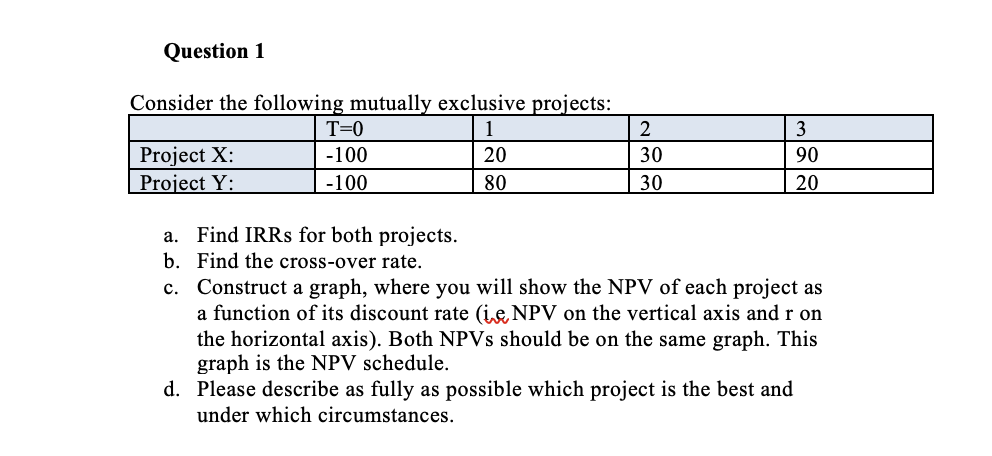
Question: Consider the following mutually exclusive projects: T=0 1 2 3 Project X: -100 20 30 90 Project Y: -100 80 30 20 Find IRRs for
-
Consider the following mutually exclusive projects:
T=0
1
2
3
Project X:
-100
20
30
90
Project Y:
-100
80
30
20
- Find IRRs for both projects.
- Find the cross-over rate.
- Construct a graph, where you will show the NPV of each project as a function of its discount rate (i.e NPV on the vertical axis and r on the horizontal axis). Both NPVs should be on the same graph. This graph is the NPV schedule.
- Please describe as fully as possible which project is the best and under which circumstances.
- Please type all your solutions into this file. The detailed solution to each question should follow the question itself.
- This is NOT a multiple-choice exam. To receive a good grade, you must show your work and write solutions in detail, including:
- a. Providing formulas in symbols. Formulas are those used in the lecture notes and the textbook. Excel or Financial Calculator formulas are NOT appropriate substitutes.
- b. Illustrating how you plug numbers, given in each question, into these formulas.
- c. Writing a short verbal summary at the end of each problem
Draw timelines and graphs to illustrate your answers.
You can use Excel for calculations. (BUT IT MUST BE DONE IN WORD)
Question 1 Consider the following mutually exclusive projects: T=0 1 Project X: -100 20 Project Y: -100 80 Jalol 2 30 30 3 90 20 a. Find IRRs for both projects. b. Find the cross-over rate. c. Construct a graph, where you will show the NPV of each project as a function of its discount rate (ie NPV on the vertical axis and r on the horizontal axis). Both NPVs should be on the same graph. This graph is the NPV schedule. d. Please describe as fully as possible which project is the best and under which circumstances
Step by Step Solution
There are 3 Steps involved in it

Get step-by-step solutions from verified subject matter experts
 Study Help