







Question: Consider the following network setup, where the Length represents the link distance and R represents the transmission rates. Suppose that the packet length is L
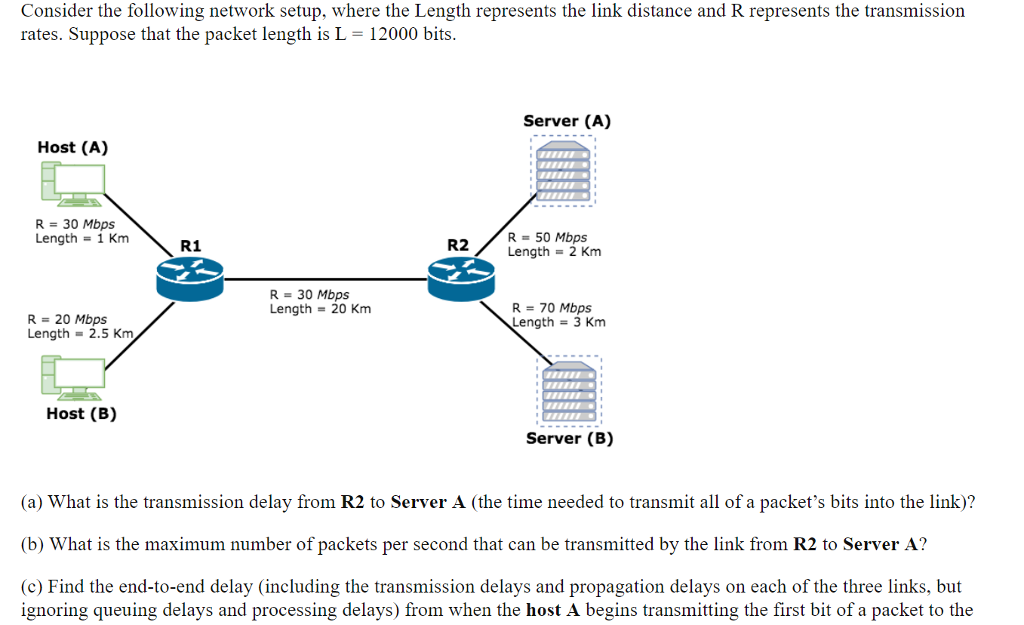
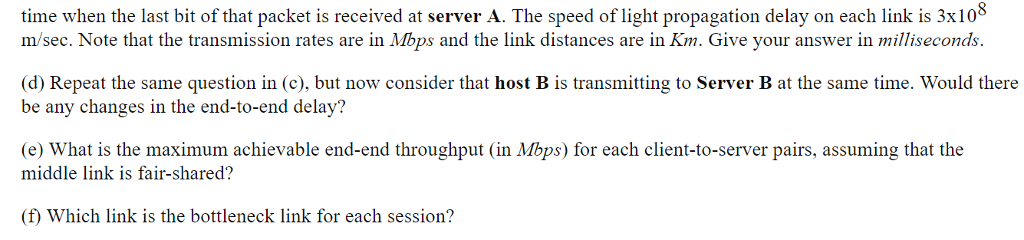
Consider the following network setup, where the Length represents the link distance and R represents the transmission rates. Suppose that the packet length is L 12000 bits Server (A) Host (A) R 30 Mbps Length = 1 Km R- 50 Mbps Length = 2 Km R1 R2 R-30 Mbps Length = 20 Km R 70 Mbps Length- 3 Km 20 Mbps Length -2.5 Km Host (B) Server (B) (a) What is the transmission delay from R2 to Server A (the time needed to transmit all of a packet's bits into the link)? (b) What is the maximum number of packets per second that can be transmitted by the link from R2 to Server A? (c) Find the end-to-end delay (including the transmission delays and propagation delays on each of the three links, but ignoring queuing delays and processing delays) from when the host A begins transmitting the first bit of a packet to the
Step by Step Solution
There are 3 Steps involved in it

Get step-by-step solutions from verified subject matter experts
 Study Help