







Question: Problem 1 Consider the following network setup, where the Length represents the link distance and R represents the transmission rates. Suppose that the packet length
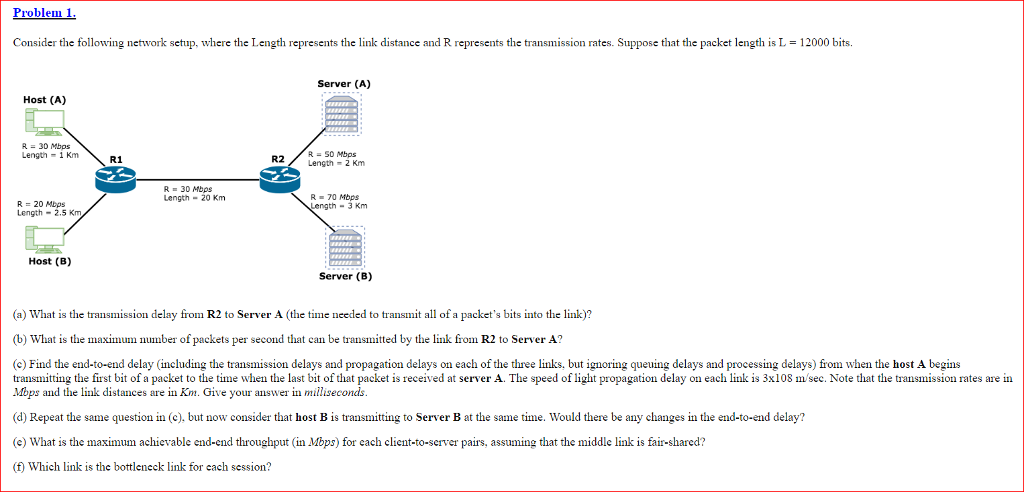
Problem 1 Consider the following network setup, where the Length represents the link distance and R represents the transmission rates. Suppose that the packet length is L 12000 bits Server (A) Host (A) R 30 Mbps Length- 1 Km R1 R2/Length 2 Km R 30 Mbps Length 20 Km R 70 Mbps R 20 Mbps Length 2.5 Km -3 Km Host (B) Server (B) (a) What is the transmision delay from R2 to Server A (the needed to transmit all of a packet's bits into the link)? (b) What is the maximum number of packets per second that can be transmitted by the link from R2 to Server A? (c) Find the end-to-end delay (including the transmission delays and propagation delays on each of the three links, but ignoring queuing delays and processing delays) from when the host A begins transmitting the first bit of a packet to the time when the last bit of that packet is received at server A. The speed of light propagation delay on each link is 3x10⁸ m/sec. Note that the transmission rates are in Mbps and the link distances are in Km. Give your answer in milliseconds (d) Repeat the same question in (c), but now consider that host B is transmiting to Server B at the same time. Would there be any changes in the end-to-end delay? (e) What is the maxium achievable end-end throughput (in Mbps) for cach client-to-server pairs, assuming that the middle link is fair-shared? (f) Which link is the bottleneck link for cach session
Step by Step Solution
There are 3 Steps involved in it

Get step-by-step solutions from verified subject matter experts
 Study Help