



Question: Consider the following packet transmission sequence. Time t = 3 2 packets lost Time t = 4 All packets successfully received Time t = 5
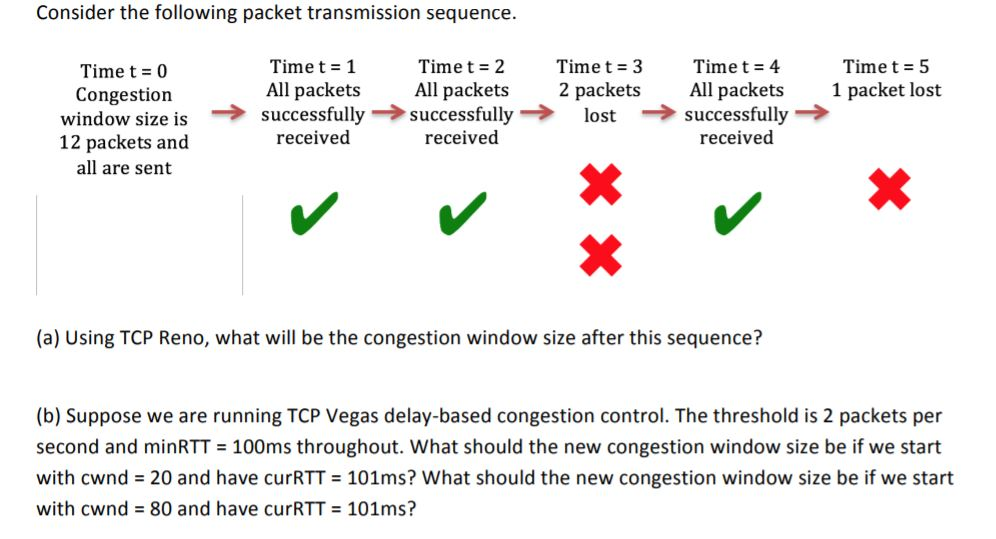
Consider the following packet transmission sequence. Time t = 3 2 packets lost Time t = 4 All packets successfully received Time t = 5 1 packet lost Time t = 1 All packets Timet=2 All packets Time t = 0 Congestion window size is 12 packets and all are sent successfully successfully received received (a) Using TCP Reno, what will be the congestion window size after this sequence? (b) Suppose we are running TCP Vegas delay-based congestion control. The threshold is 2 packets per second and minRTT = 100ms throughout, what should the new congestion window size be if we start with cwnd = 20 and have curRTT = 101ms? what should the new congestion window size be if we start with cwnd = 80 and have curRTT = 101ms? Consider the following packet transmission sequence. Time t = 3 2 packets lost Time t = 4 All packets successfully received Time t = 5 1 packet lost Time t = 1 All packets Timet=2 All packets Time t = 0 Congestion window size is 12 packets and all are sent successfully successfully received received (a) Using TCP Reno, what will be the congestion window size after this sequence? (b) Suppose we are running TCP Vegas delay-based congestion control. The threshold is 2 packets per second and minRTT = 100ms throughout, what should the new congestion window size be if we start with cwnd = 20 and have curRTT = 101ms? what should the new congestion window size be if we start with cwnd = 80 and have curRTT = 101ms
Step by Step Solution
There are 3 Steps involved in it

Get step-by-step solutions from verified subject matter experts