







Question: Reliable Transfer Protocol rdt 3.0 is a stop-and-wait protocol a. [2 points] Consider the rdt3.0 protocol on pages 214-217 of the textbook. Define the utilization,
Reliable Transfer Protocol
rdt 3.0 is a stop-and-wait protocol
![Reliable Transfer Protocol rdt 3.0 is a stop-and-wait protocol a. [2 points]](https://dsd5zvtm8ll6.cloudfront.net/si.experts.images/questions/2024/09/66f0bf731bd2c_68266f0bf7273e85.jpg)
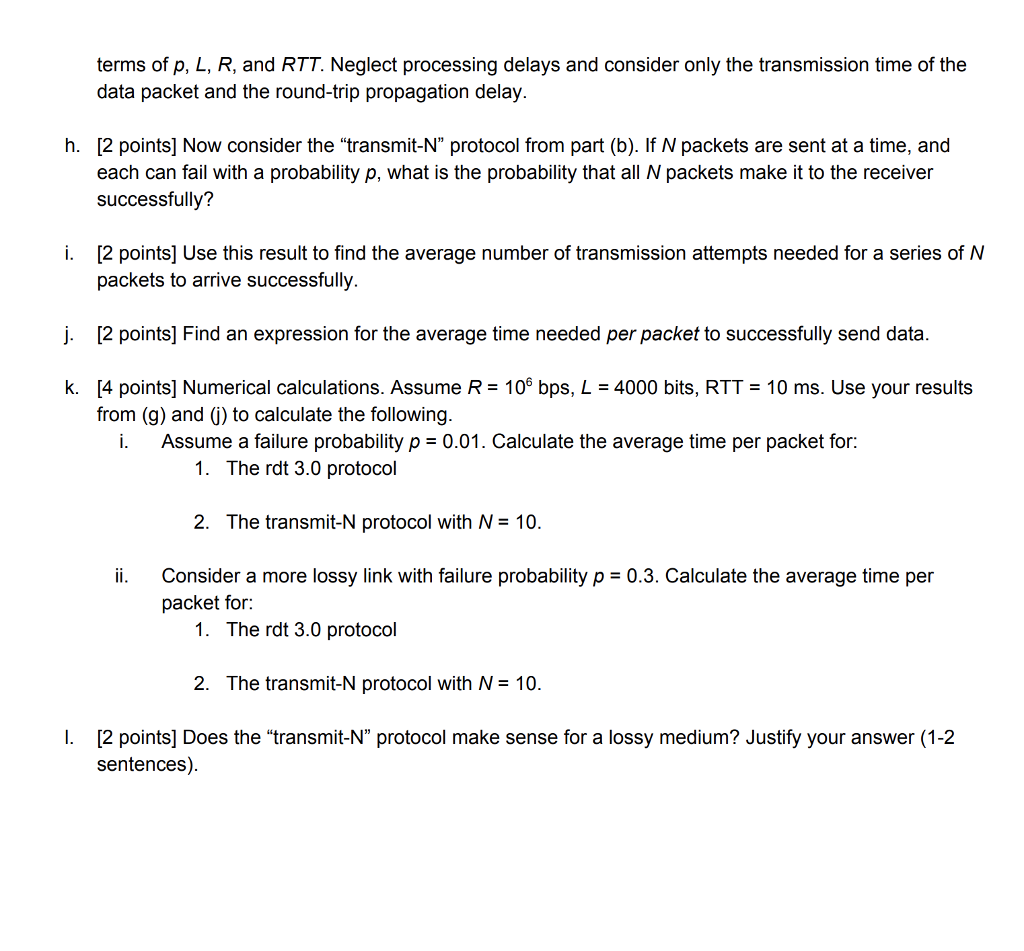
a. [2 points] Consider the rdt3.0 protocol on pages 214-217 of the textbook. Define the utilization, U, of a link to be the ratio of the time spent actively sending data to the total time needed for the protocol. For example, if a host transmits data for 1 second and then waits for 9 seconds, the utilization would 1/10 Find a formula for the utilization of a host sending packets of length L bits over a wire with a transmission rate R, with a round-trip propagation time RTT. Assume that no packets or ACKs are lost, and neglect the transmission time of ACKs b. [2 points] Consider now an alternative "transmit-N protocol that sends N packets sequentially before stopping to wait for an ACK. The receiver expects N packets and will respond either with an ACK saying that all N packets were retrieved successfully or nothing at all (and the sender will timeout after one RTT and retransmit all N packets). Find a formula for the utilization in this case c. [4 points] Assume the transmission rate R is 1 Mbps (106 bits), the packet size L is 4000 bits, and the round-trip time RTT is 10 ms i. Calculate a numerical result using the formula you found for the rdt protocol in part (a) Calculate a numerical result using the formula you found for the "transmit-N" protocol in (b) Assume a window N = 10 ii. ii. How does the link utilization change with N? iv. If N is the only variable we can change, how would we maximize utilization? d. [2 points] Imagine a protocol in which the sender continuously sends packets to the receiver to achieve perfect link utilization. The receiver simply sends an ACK for each packet received and buffers out of order packets. The sender will keep a separate timer for each packet it sends. If arn ACK is not received for a packet before it times out, the sender will retransmit that individual packet before continuing to send where it left off. Give one major drawback to this protocol that makes it unreasonable e. [2 points] Give another major drawback to the protocol described in (d) [2 points] Consider again the rdt3.0 protocol with the same parameters as part (a). Assume that each data packet sent will fail with a probability p. Assume that ACKs are always sent successfully. What is the average number of transmission attempts, in terms of p, that will be needed to successfully send a packet? (Hint: Would this follow a binomial, geometric, or poisson distribution, and why?) f. g. [2 points] Using your answer in (f), derive an expression for the average time it takes to successfully send a packet, measuring from when the sender first starts transmitting until the ACK is received, in a. [2 points] Consider the rdt3.0 protocol on pages 214-217 of the textbook. Define the utilization, U, of a link to be the ratio of the time spent actively sending data to the total time needed for the protocol. For example, if a host transmits data for 1 second and then waits for 9 seconds, the utilization would 1/10 Find a formula for the utilization of a host sending packets of length L bits over a wire with a transmission rate R, with a round-trip propagation time RTT. Assume that no packets or ACKs are lost, and neglect the transmission time of ACKs b. [2 points] Consider now an alternative "transmit-N protocol that sends N packets sequentially before stopping to wait for an ACK. The receiver expects N packets and will respond either with an ACK saying that all N packets were retrieved successfully or nothing at all (and the sender will timeout after one RTT and retransmit all N packets). Find a formula for the utilization in this case c. [4 points] Assume the transmission rate R is 1 Mbps (106 bits), the packet size L is 4000 bits, and the round-trip time RTT is 10 ms i. Calculate a numerical result using the formula you found for the rdt protocol in part (a) Calculate a numerical result using the formula you found for the "transmit-N" protocol in (b) Assume a window N = 10 ii. ii. How does the link utilization change with N? iv. If N is the only variable we can change, how would we maximize utilization? d. [2 points] Imagine a protocol in which the sender continuously sends packets to the receiver to achieve perfect link utilization. The receiver simply sends an ACK for each packet received and buffers out of order packets. The sender will keep a separate timer for each packet it sends. If arn ACK is not received for a packet before it times out, the sender will retransmit that individual packet before continuing to send where it left off. Give one major drawback to this protocol that makes it unreasonable e. [2 points] Give another major drawback to the protocol described in (d) [2 points] Consider again the rdt3.0 protocol with the same parameters as part (a). Assume that each data packet sent will fail with a probability p. Assume that ACKs are always sent successfully. What is the average number of transmission attempts, in terms of p, that will be needed to successfully send a packet? (Hint: Would this follow a binomial, geometric, or poisson distribution, and why?) f. g. [2 points] Using your answer in (f), derive an expression for the average time it takes to successfully send a packet, measuring from when the sender first starts transmitting until the ACK is received, in
Step by Step Solution
There are 3 Steps involved in it

Get step-by-step solutions from verified subject matter experts
 Study Help