


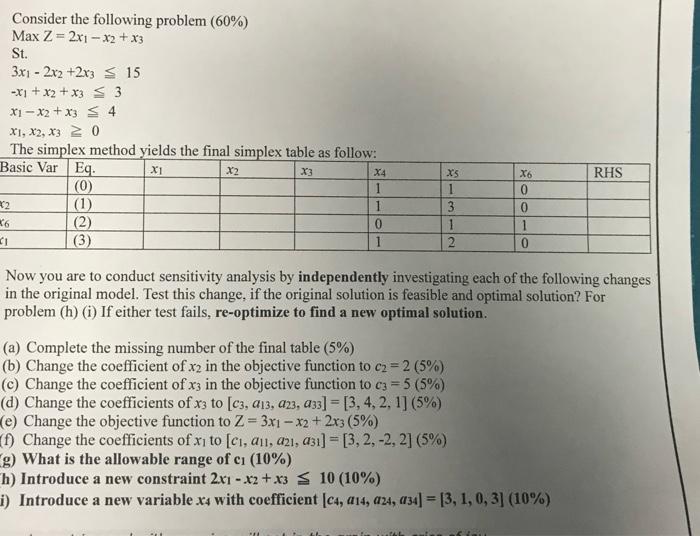
Question: Consider the following problem (60%) Max Z= 2x1 - x2 + x3 St. 3x1 - 2x2 +2x3 = 15 -x1 + x2 + x3 S
Consider the following problem (60%) Max Z= 2x1 -
Consider the following problem (60%) Max Z= 2x1 - x2 + x3 St. 3x1 - 2x2 +2x3 = 15 -x1 + x2 + x3 S 3 x1 - x2 + x3 5 4 X1, X2, X3 20 The simplex method yields the final simplex table as follow: Basic Var Eq. X2 X3 (0) 1 (2) 0 1 (3) 1 X1 RHS X6 0 0 1 0 K6 | ||| Now you are to conduct sensitivity analysis by independently investigating each of the following changes in the original model. Test this change, if the original solution is feasible and optimal solution? For problem (h) (i) If either test fails, re-optimize to find a new optimal solution. (a) Complete the missing number of the final table (5%) (b) Change the coefficient of x2 in the objective function to cz = 2 (5%) (c) Change the coefficient of x3 in the objective function to cz = 5(5%) (d) Change the coefficients of x3 to [c3, 213, a23, 233] = [3, 4, 2, 1] (5%) (e) Change the objective function to Z = 3x1 - x2 + 2x3 (5%) (1) Change the coefficients of xito (C1,011, 221, a31] = [3, 2, -2,2] (5%) g) What is the allowable range of c1 (10%) h) Introduce a new constraint 2x1 - x2 + x3 10 (10%) i) Introduce a new variable xs with coefficient (C4, 214, 024, 034] = 3, 1, 0,3] (10%)

Step by Step Solution

There are 3 Steps involved in it

1 Expert Approved Answer
Step: 1 Unlock blur-text-image

Question Has Been Solved by an Expert!

Get step-by-step solutions from verified subject matter experts

Step: 2 Unlock
Step: 3 Unlock

Students Have Also Explored These Related General Management Questions!