







Question: Consider the following recursive algorithm powerset: Algorithm powerset(A): If A return 0) else do { pick a E A, set A:--A {a), set P
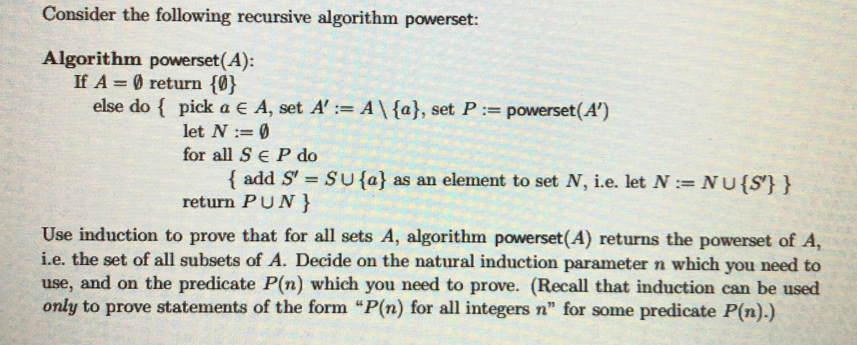
Consider the following recursive algorithm powerset: Algorithm powerset(A): If A return 0) else do { pick a E A, set A":--A \ {a), set P :--powerset(A') let N:0 for all S P do add S SUfa as an element to set N, i.e. let N NU(Sy h return PUN Use induction to prove that for all sets A, algorithm powerset(A) returns the powerset of A, i.e. the set of all subsets of A. Decide on the natural induction parameter n which you need to use, and on the predicate P(n) which you need to prove. (Recall that induction can be used only to prove statements of the form "P(n) for all integers n" for some predicate P(n).) Consider the following recursive algorithm powerset: Algorithm powerset(A): If A return 0) else do { pick a E A, set A":--A \ {a), set P :--powerset(A') let N:0 for all S P do add S SUfa as an element to set N, i.e. let N NU(Sy h return PUN Use induction to prove that for all sets A, algorithm powerset(A) returns the powerset of A, i.e. the set of all subsets of A. Decide on the natural induction parameter n which you need to use, and on the predicate P(n) which you need to prove. (Recall that induction can be used only to prove statements of the form "P(n) for all integers n" for some predicate P(n).)
Step by Step Solution
There are 3 Steps involved in it

Get step-by-step solutions from verified subject matter experts
 Study Help