







Question: Consider the following relational schema and SQL query: (A) Trace the System R dynamic programming algorithm on this query. (B) Give a relational algebra tree
Consider the following relational schema and SQL query:
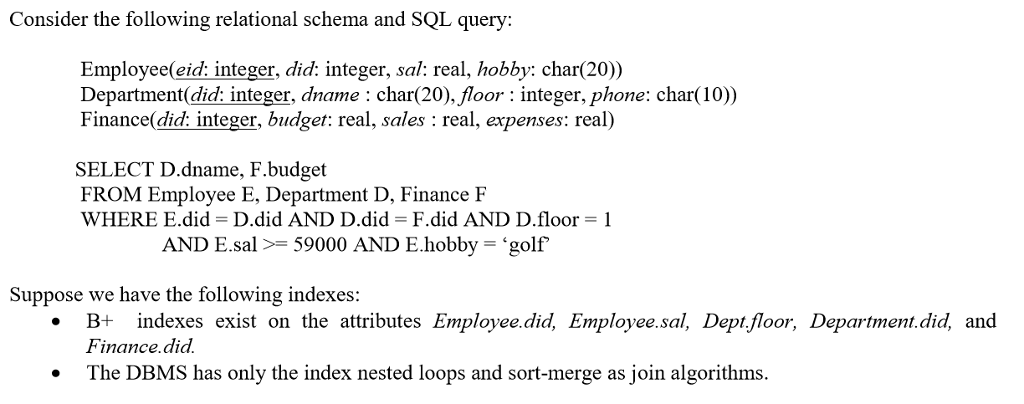
(A) Trace the System R dynamic programming algorithm on this query.
(B) Give a relational algebra tree that is reasonably efficient (Hint: think of algebraic equivalences)
Consider the following relational schema and SQL query: Employee(eid: integer, did: integer, sal: real, hobby: char(20)) Department(did: integer, dname : char(20), floor: integer, phone: char(10)) Finance(did: integer, budget: real, sales: real, expenses: real) SELECT D.dname, F.budget FROM Employee E, Department D, Finance F WHERE E.did-D.did AND D.did-F.did AND D.floor 1 AND E.sal >= 59000 AND E.hobby = 'golf' Suppose we have the following indexes: Bt indexes exist on the attributes Employee.did, Employee.sal, Dept.floor, Department.did, and Finance.did. The DBMS has only the index nested loops and sort-merge as join algorithms Consider the following relational schema and SQL query: Employee(eid: integer, did: integer, sal: real, hobby: char(20)) Department(did: integer, dname : char(20), floor: integer, phone: char(10)) Finance(did: integer, budget: real, sales: real, expenses: real) SELECT D.dname, F.budget FROM Employee E, Department D, Finance F WHERE E.did-D.did AND D.did-F.did AND D.floor 1 AND E.sal >= 59000 AND E.hobby = 'golf' Suppose we have the following indexes: Bt indexes exist on the attributes Employee.did, Employee.sal, Dept.floor, Department.did, and Finance.did. The DBMS has only the index nested loops and sort-merge as join algorithms
Step by Step Solution
There are 3 Steps involved in it

Get step-by-step solutions from verified subject matter experts
 Study Help