







Question: Consider the following relations on {a, b, c,d}: R1 = {(a,a), (a,b), (b,b), (b,c), (c,c), (c,d)} R2 = {(a,a), (a,b), (a,c), (b,b),(b,a), (c,d),(d,d)} R3=
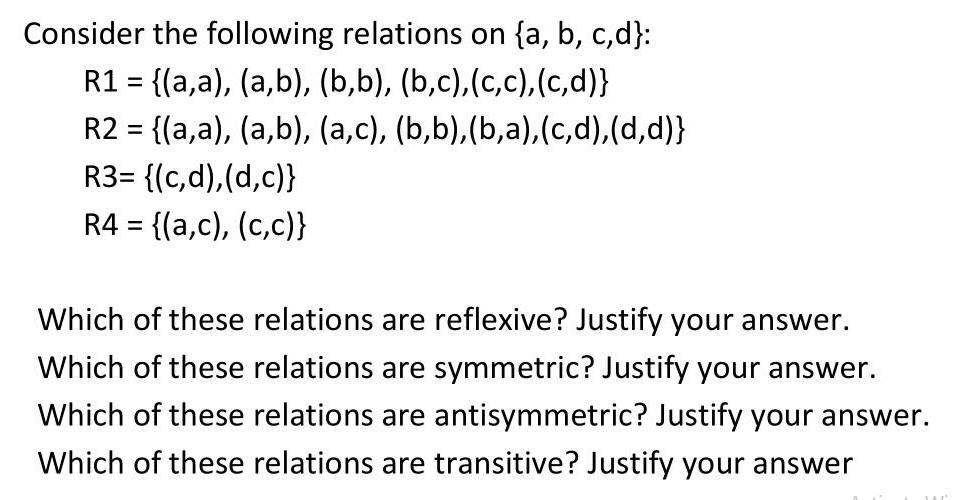
Consider the following relations on {a, b, c,d}: R1 = {(a,a), (a,b), (b,b), (b,c), (c,c), (c,d)} R2 = {(a,a), (a,b), (a,c), (b,b),(b,a), (c,d),(d,d)} R3= {(c,d),(d,c)} R4 = {(a,c), (c,c)} Which of these relations are reflexive? Justify your answer. Which of these relations are symmetric? Justify your answer. Which of these relations are antisymmetric? Justify your answer. Which of these relations are transitive? Justify your answer
Step by Step Solution
3.44 Rating (154 Votes )
There are 3 Steps involved in it
Lets analyze each of the relations R1 a a a b b b b c c c c d 1 Reflexive A relation R is reflexive if and only if a a b b and c c are in R In R1 we h... View full answer

Get step-by-step solutions from verified subject matter experts
 Study Help