







Question: Consider the following scenario: (a) (b) () (d) (e) e Let P(C) = 0.2 Let P(D) = 0.3 Let P(C | D) = 0.4 Find
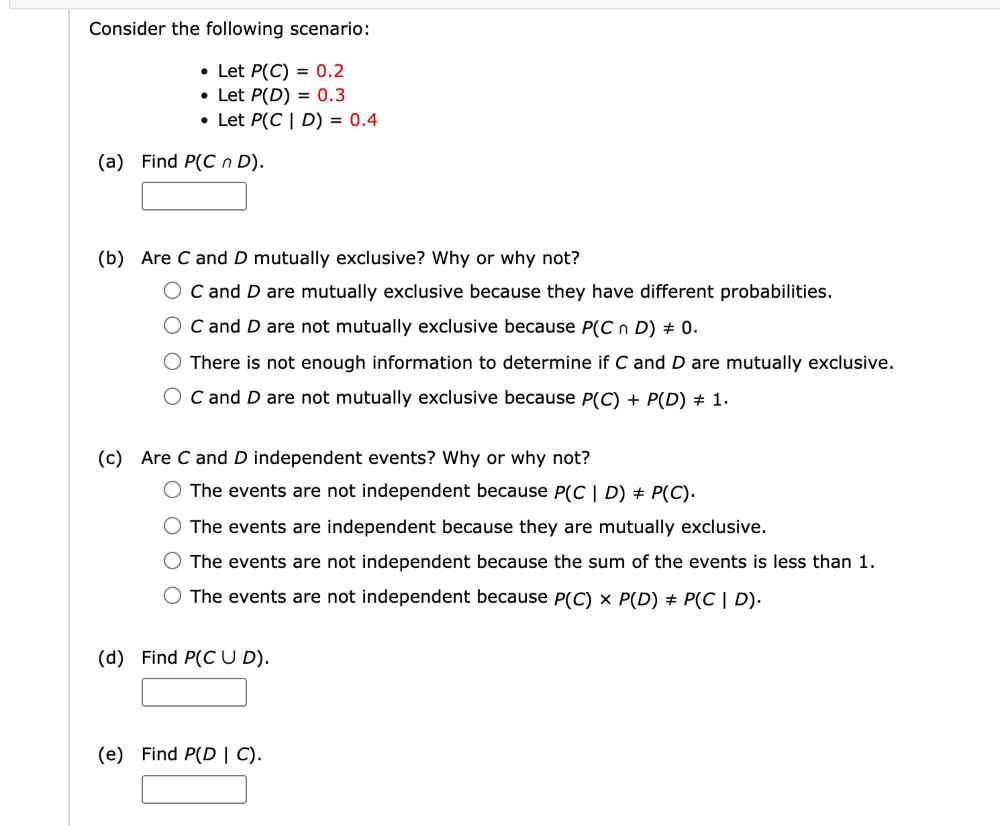
Consider the following scenario: (a) (b) () (d) (e) e Let P(C) = 0.2 Let P(D) = 0.3 Let P(C | D) = 0.4 Find P(C n D). | Are C and D mutually exclusive? Why or why not? () C and D are mutually exclusive because they have different probabilities. () C and D are not mutually exclusive because P(C n D) # 0. () There is not enough information to determine if C and D are mutually exclusive. (U C and D are not mutually exclusive because P(C) + P(D) + 1. Are C and D independent events? Why or why not? (0 The events are not independent because p(C | D) # P(C). (O) The events are independent because they are mutually exclusive. (U The events are not independent because the sum of the events is less than 1. () The events are not independent because P(C) x P(D) + P(C | D). Find P(C U D). | Find P(D | C). | |
Step by Step Solution
There are 3 Steps involved in it

Get step-by-step solutions from verified subject matter experts
 Study Help