





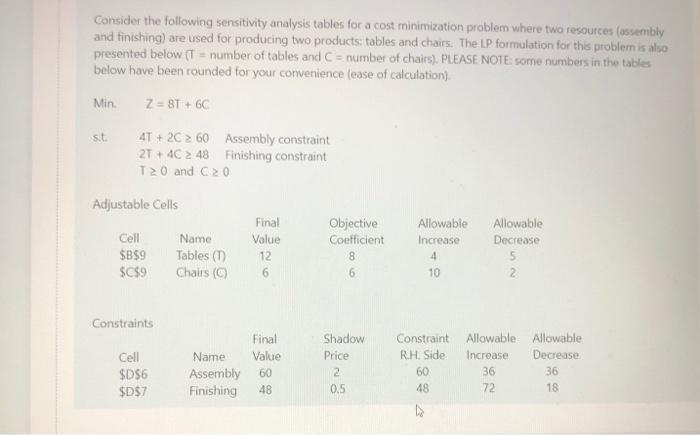
Question: Consider the following sensitivity analysis tables for a cost minimization problem where two resources (assembly and finishing) are used for producing two products: tables and
Consider the following sensitivity analysis
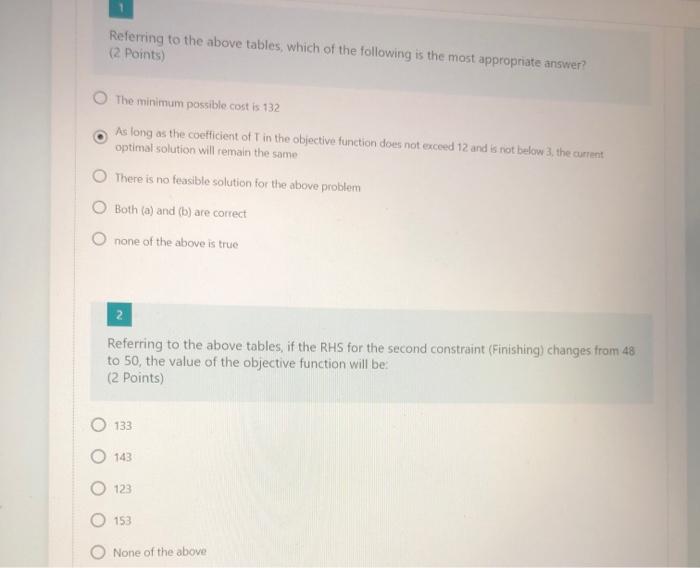
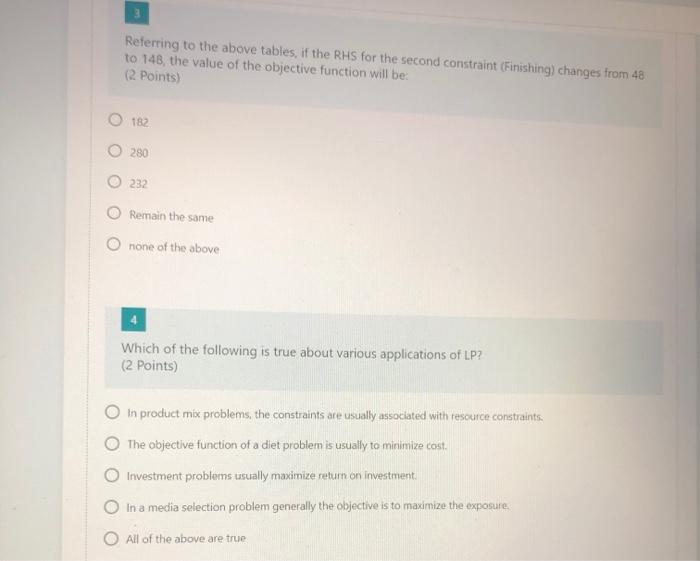
Consider the following sensitivity analysis tables for a cost minimization problem where two resources (assembly and finishing) are used for producing two products: tables and chairs. The LP formulation for this problem is also presented below (T = number of tables and C= number of chairs). PLEASE NOTE some numbers in the tables below have been rounded for your convenience (ease of calculation) Min Z = 81 +6C st 4T + 2C 2 60 Assembly constraint 2T + 4C 2 48 Finishing constraint T20 and 20 Adjustable Cells Cell $B$9 $C$9 Name Tables (1) Chairs (0) Final Value 12 6 Objective Coefficient 8 6 Allowable Increase 4 10 Allowable Decrease 5 2 Constraints Cell $D$6 $D$7 Name Assembly Finishing Final Value 60 48 Shadow Price 2 0.5 Constraint R.H. Side 60 48 Allowable: Allowable Increase Decrease 36 36 72 18 Referring to the above tables, which of the following is the most appropriate answer? (2 points) The minimum possible cost is 132 As long as the coefficient of in the objective function does not exceed 12 and is not below 3, the current optimal solution will remain the same There is no feasible solution for the above problem O Both (a) and (b) are correct O none of the above is true Referring to the above tables, if the RHS for the second constraint (Finishing changes from 48 to 50, the value of the objective function will be (2 points) 133 143 0 0 123 153 None of the above Referring to the above tables, if the RHS for the second constraint (Finishing) changes from 48 to 148, the value of the objective function will be (2 points) 182 O 280 232 Remain the same O none of the above Which of the following is true about various applications of LP? (2 points) In product mix problems, the constraints are usually associated with resource constraints. The objective function of a diet problem is usually to minimize cost Investment problems usually maximize return on investment In a media selection problem generally the objective is to maximize the exposure. O All of the above are true
Step by Step Solution

There are 3 Steps involved in it

1 Expert Approved Answer
Step: 1 Unlock blur-text-image

Question Has Been Solved by an Expert!

Get step-by-step solutions from verified subject matter experts

Step: 2 Unlock
Step: 3 Unlock

Students Have Also Explored These Related General Management Questions!