







Question: Consider the following syntax for a term in the unsugared untyped calculus, represented as an s-expression: E::=(E)(EE) where v is a variable. For example, the
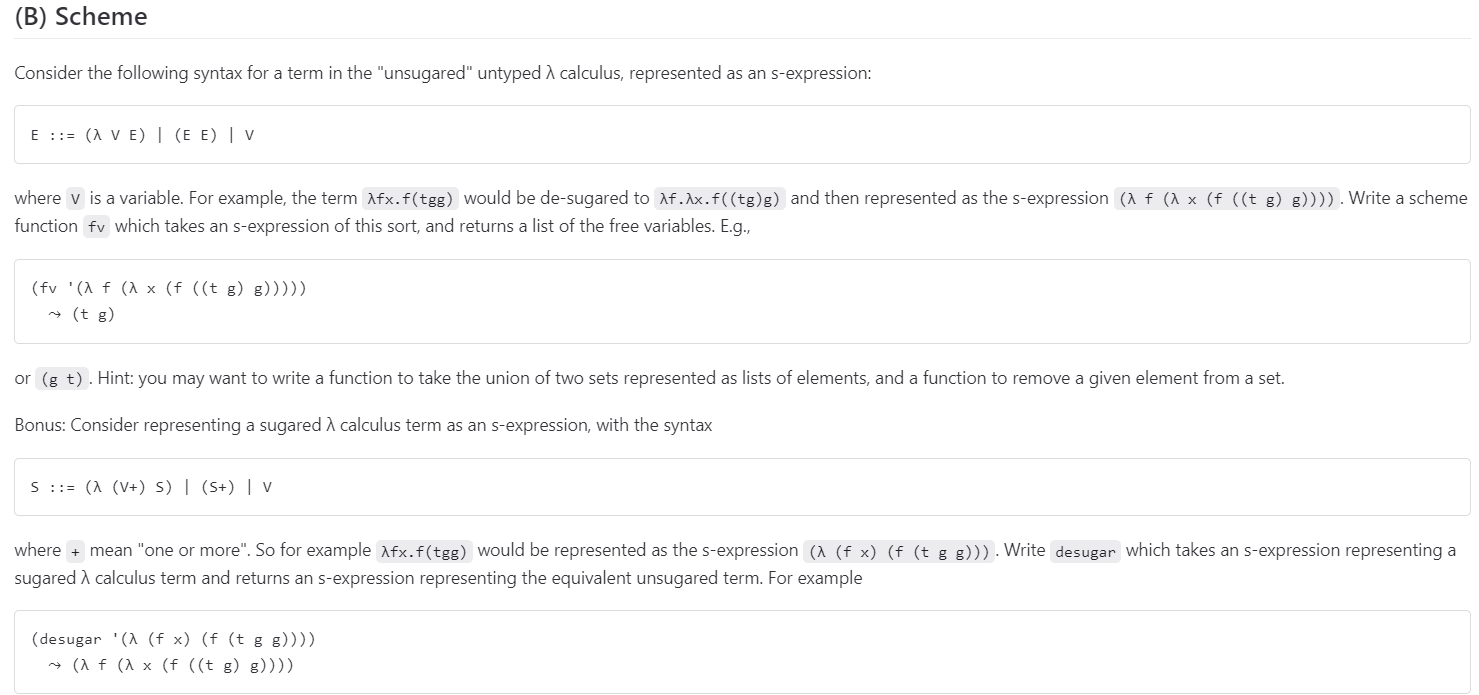
Consider the following syntax for a term in the "unsugared" untyped calculus, represented as an s-expression: E::=(E)(EE) where v is a variable. For example, the term fx.f(tgg) would be de-sugared to f.x.f((tg)g) and then represented as the s-expression ( f((f((tg)g))). Write a scheme function fv which takes an s-expression of this sort, and returns a list of the free variables. E.g., (fv(f((f((tg)g)))))(tg) or ( gt). Hint: you may want to write a function to take the union of two sets represented as lists of elements, and a function to remove a given element from a set. Bonus: Consider representing a sugared calculus term as an s-expression, with the syntax s::=((v+)s)(s+)v where mean "one or more". So for example ffx.f(tgg) would be represented as the s-expression ((fx)(f(tgg))). Write sugared calculus term and returns an s-expression representing the equivalent unsugared term. For example (desugar((fx)(f(tgg)))))(f(x(f((tg)g))))
Step by Step Solution
There are 3 Steps involved in it

Get step-by-step solutions from verified subject matter experts
 Study Help