







Question: Consider the following system if linear equations Fall ID MULTIPLE CHOICE - Select the one beat answer ipt each [Except * 1 pt 4 pt
Consider the following system if linear equations
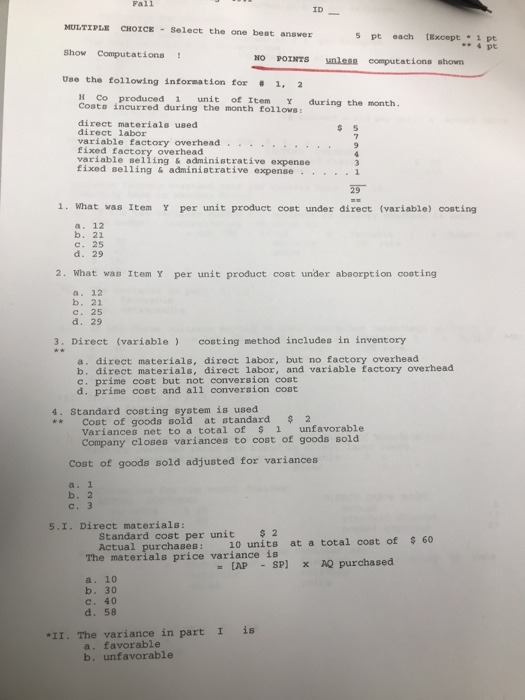
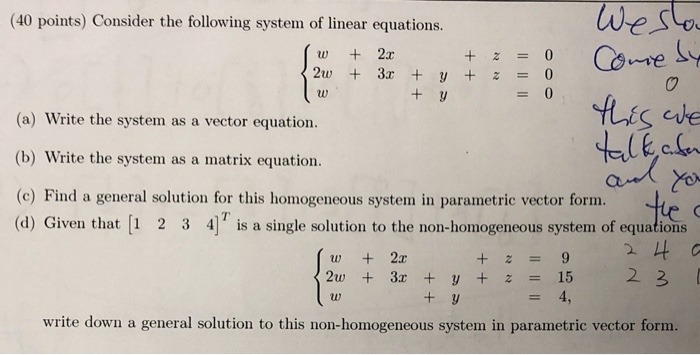
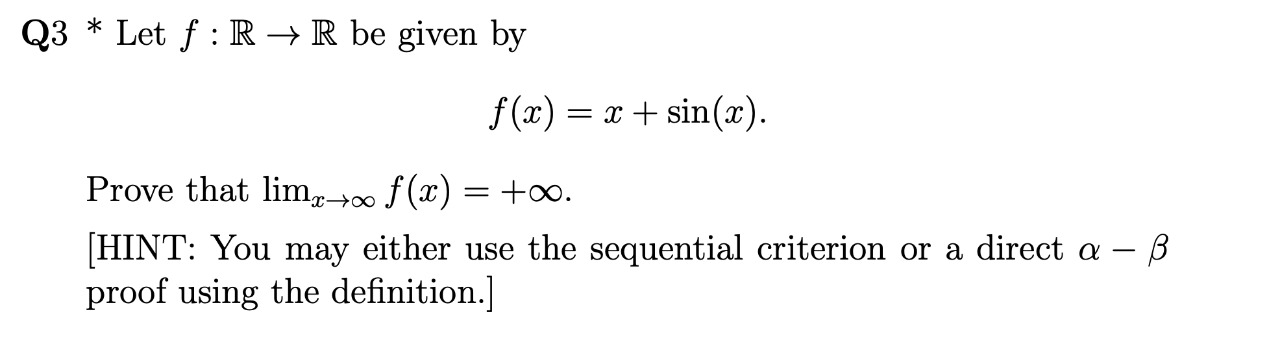
Fall ID MULTIPLE CHOICE - Select the one beat answer ipt each [Except * 1 pt 4 pt Show Computations NO POINTS computations shown Use the following information for 1, 2 I Co produced 1 unit of Item Y Coats incurred during the month follows during the month. direct materials used direct labor variable factory overhead fixed factory overhead variable selling & administrative expense fixed selling & administrative expense . 29 1. What was Item Y per unit product cost under direct (variable) coating 12 b. 21 C. 25 d. 29 2. What was Item Y per unit product cost under absorption costing a. 12 b. 21 0. 25 d. 29 3. Direct (variable ) costing method includes in inventory direct materials, direct labor, but no factory overhead b. direct materials, direct labor, and variable factory overhead c. prime cost but not conversion cost d. prime cost and all conversion cost 4. Standard costing system is used Cost of goods sold at standard $ 2 Variances not to a total of $ 1 unfavorable Company closes variances to cost of goods sold Cost of goods sold adjusted for variances 1 C . 5. 1. Direct materials: Standard cost per unit $ 2 Actual purchases: 10 units at a total cost of $ 60 The materials price variance is = [AP - SP] x AQ purchased a. 10 b. 30 C . 40 d. 58 "II. The variance in part I is a. favorable b. unfavorable(40 points) Consider the following system of linear equations. We Sho. 2x = Come Sy 2w 3x + 0 0 0 O + (a) Write the system as a vector equation. this we talk, aber (b) Write the system as a matrix equation. and yo (c) Find a general solution for this homogeneous system in parametric vector form. the (d) Given that [1 2 3 4)1 is a single solution to the non-homogeneous system of equations 2 4 2x + 2w + 3x + 15 2 3 + write down a general solution to this non-homogeneous system in parametric vector form.Q3 * Let f : R - R be given by f (2) = x + sin(a). Prove that limx- f () = too. HINT: You may either use the sequential criterion or a direct a - B proof using the definition
Step by Step Solution
There are 3 Steps involved in it

Get step-by-step solutions from verified subject matter experts
 Study Help