







Question: Consider the following two assets: - Asset A's expected return is 4% and return standard deviation is 42%. Asset B's expected return is 1.5%
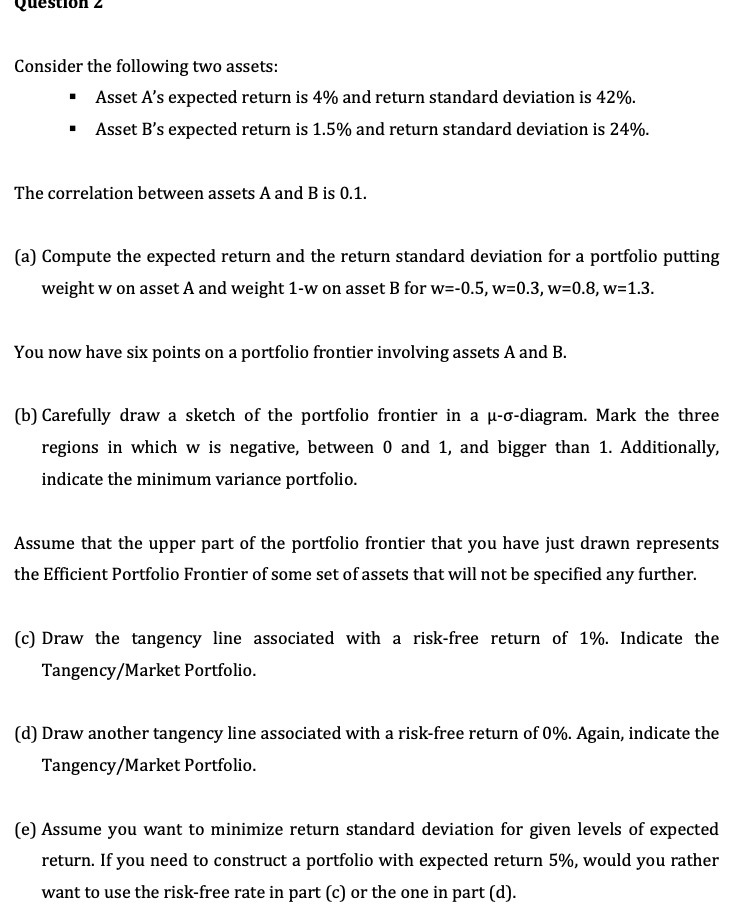
Consider the following two assets: - Asset A's expected return is 4% and return standard deviation is 42%. " Asset B's expected return is 1.5% and return standard deviation is 24%. The correlation between assets A and B is 0.1. (a) Compute the expected return and the return standard deviation for a portfolio putting weight w on asset A and weight 1-w on asset B for w=-0.5, w=0.3, w=0.8, w=1.3. You now have six points on a portfolio frontier involving assets A and B. (b) Carefully draw a sketch of the portfolio frontier in a p-o-diagram. Mark the three regions in which w is negative, between 0 and 1, and bigger than 1. Additionally, indicate the minimum variance portfolio. Assume that the upper part of the portfolio frontier that you have just drawn represents the Efficient Portfolio Frontier of some set of assets that will not be specified any further. (c) Draw the tangency line associated with a risk-free return of 1%. Indicate the Tangency/Market Portfolio. (d) Draw another tangency line associated with a risk-free return of 0%. Again, indicate the Tangency/Market Portfolio. (e) Assume you want to minimize return standard deviation for given levels of expected return. If you need to construct a portfolio with expected return 5%, would you rather want to use the risk-free rate in part (c) or the one in part (d)
Step by Step Solution
There are 3 Steps involved in it

Get step-by-step solutions from verified subject matter experts
 Study Help