



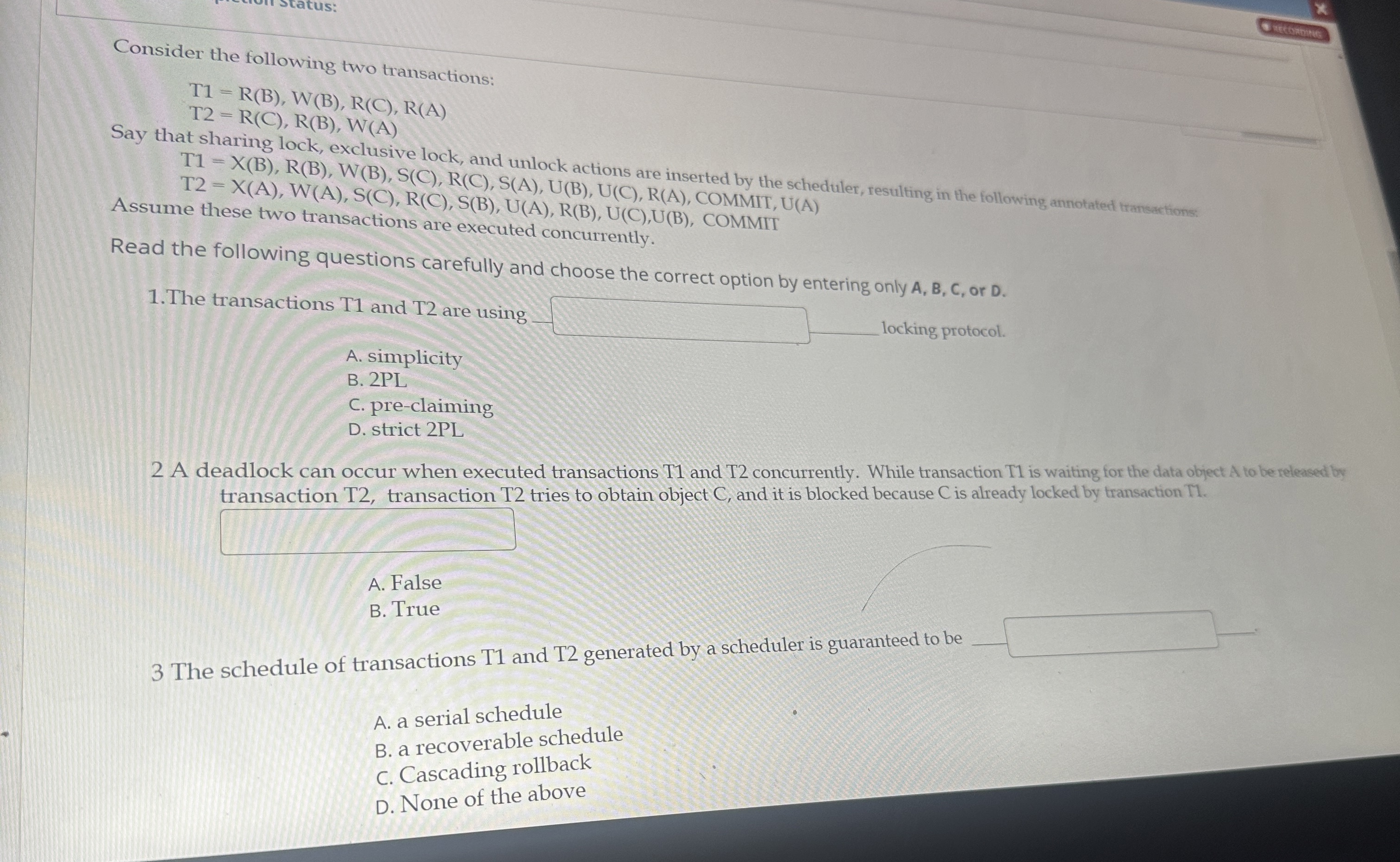
Question: Consider the following two transactions: T 1 = R ( B ) , W ( B ) , R ( C ) , R (
Consider the following two transactions:
Say that sharing lock, exclusive lock, and unlock actions are inserted by the scheduler, resulting in the following annotated transections:
COMMIT,
COMMIT Assume these two transactions are executed concurrently.
Read the following questions carefully and choose the correct option by entering only A B C or D
The transactions T and T are using
locking protocol.
A simplicity
BPL
C preclaiming
D strict PL
A deadlock can occur when executed transactions T and T concurrently. While transaction is waiting for the data object A to be releasedby transaction T transaction T tries to obtain object C and it is blocked because C is already locked by transaction TI
A False
B True
The schedule of transactions T and T generated by a scheduler is guaranteed to be
A a serial schedule
B a recoverable schedule
C Cascading rollback
D None of the above
Step by Step Solution
There are 3 Steps involved in it
1 Expert Approved Answer
Step: 1 Unlock

Question Has Been Solved by an Expert!
Get step-by-step solutions from verified subject matter experts
Step: 2 Unlock
Step: 3 Unlock