







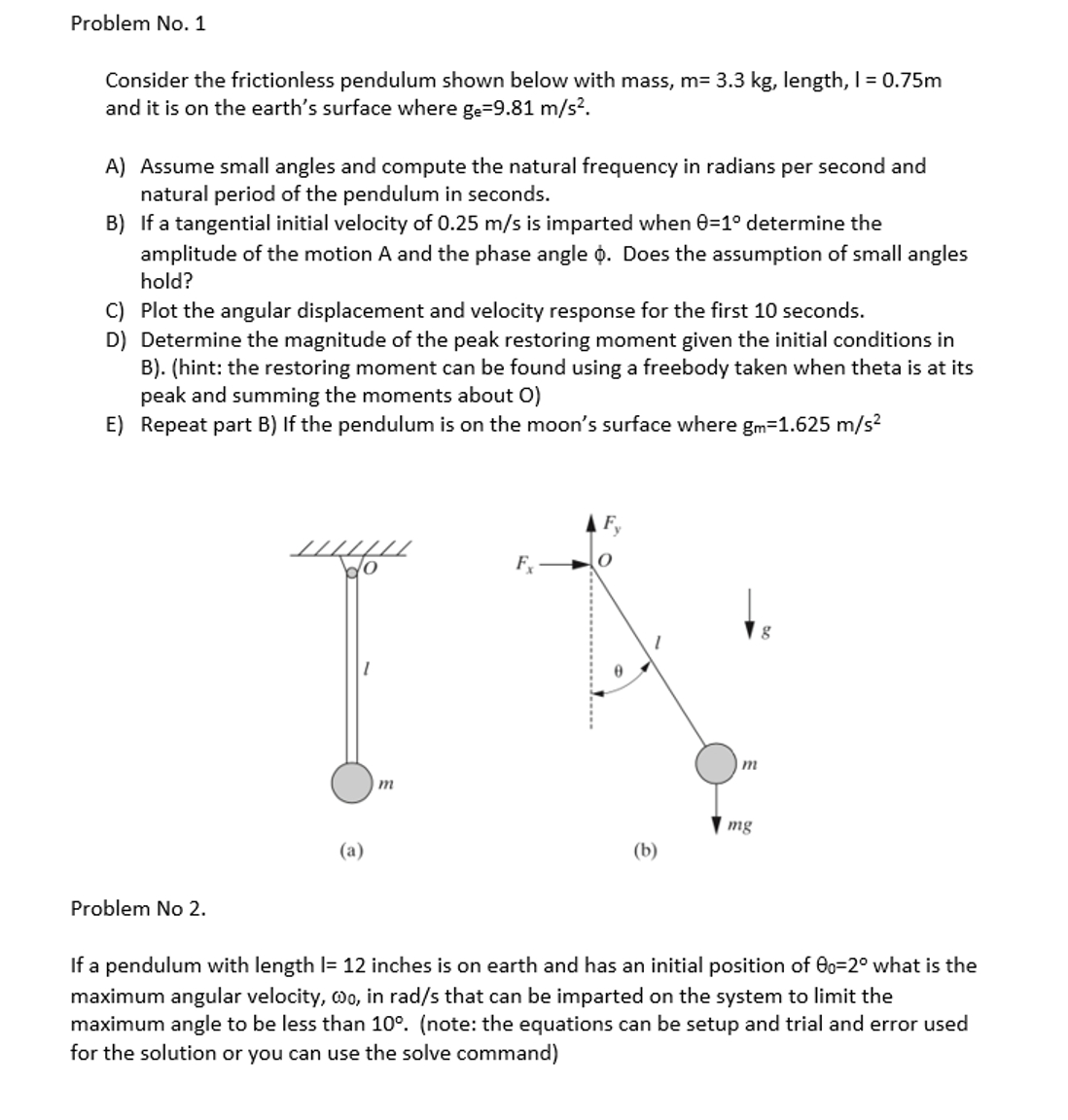
Question: Consider the frictionless pendulum shown below with mass, m = 3 . 3 kg , length, l = 0 . 7 5 m and it
Consider the frictionless pendulum shown below with mass, m kg length, l m and it is on the earths surface where ge ms Problem No
Consider the frictionless pendulum shown below with mass, length,
and it is on the earth's surface where
A Assume small angles and compute the natural frequency in radians per second and
natural period of the pendulum in seconds.
B If a tangential initial velocity of is imparted when determine the
amplitude of the motion A and the phase angle Does the assumption of small angles
hold?
C Plot the angular displacement and velocity response for the first seconds.
D Determine the magnitude of the peak restoring moment given the initial conditions in
Bhint: the restoring moment can be found using a freebody taken when theta is at its
peak and summing the moments about
E Repeat part B If the pendulum is on the moon's surface where
Problem No
If a pendulum with length inches is on earth and has an initial position of what is the
maximum angular velocity, in rads that can be imparted on the system to limit the
maximum angle to be less than note: the equations can be setup and trial and error used
for the solution or you can use the solve command
A Assume small angles and compute the natural frequency in radians per second and natural period of the pendulum in seconds.
B If a tangential initial velocity of ms is imparted when o determine the amplitude of the motion A and the phase angle Does the assumption of small angles hold?
C Plot the angular displacement and velocity response for the first seconds.
D Determine the magnitude of the peak restoring moment given the initial conditions in Bhint: the restoring moment can be found using a freebody taken when theta is at its peak and summing the moments about O
E Repeat part B If the pendulum is on the moons surface where gm ms
Step by Step Solution
There are 3 Steps involved in it
1 Expert Approved Answer
Step: 1 Unlock

Question Has Been Solved by an Expert!
Get step-by-step solutions from verified subject matter experts
Step: 2 Unlock
Step: 3 Unlock
 Study Help