







Question: Consider the function f defined by f(x) its domain. a) First compute lim f(x). Answer: 4/5 H4X 4+5e e-3x 5-16e-3x and Q(x)? FORMATTING: b)
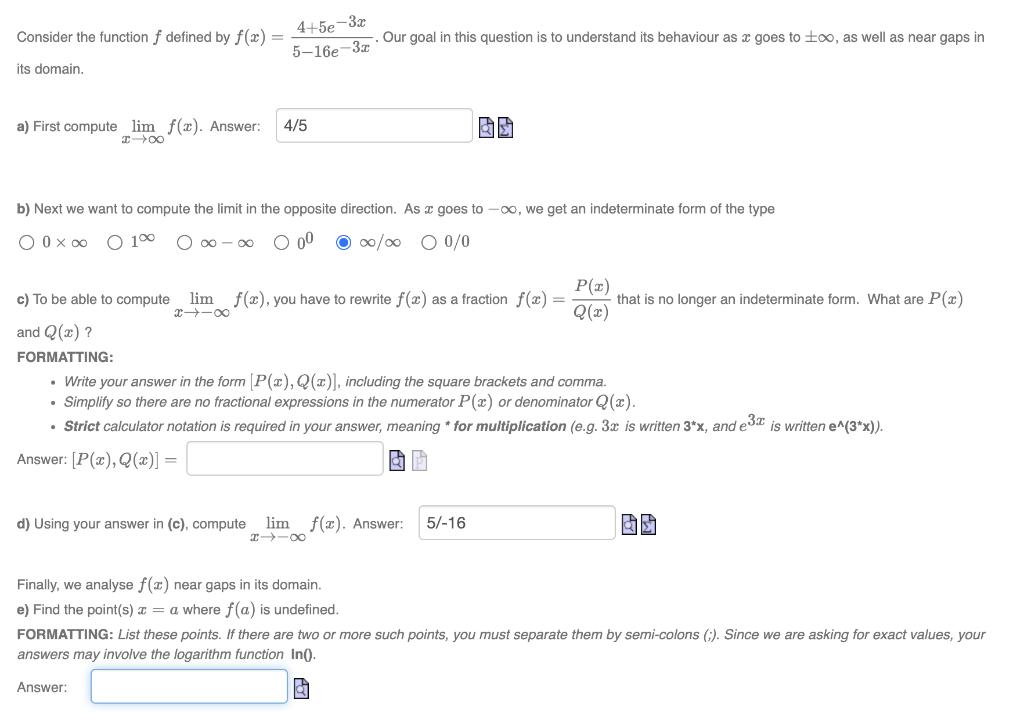
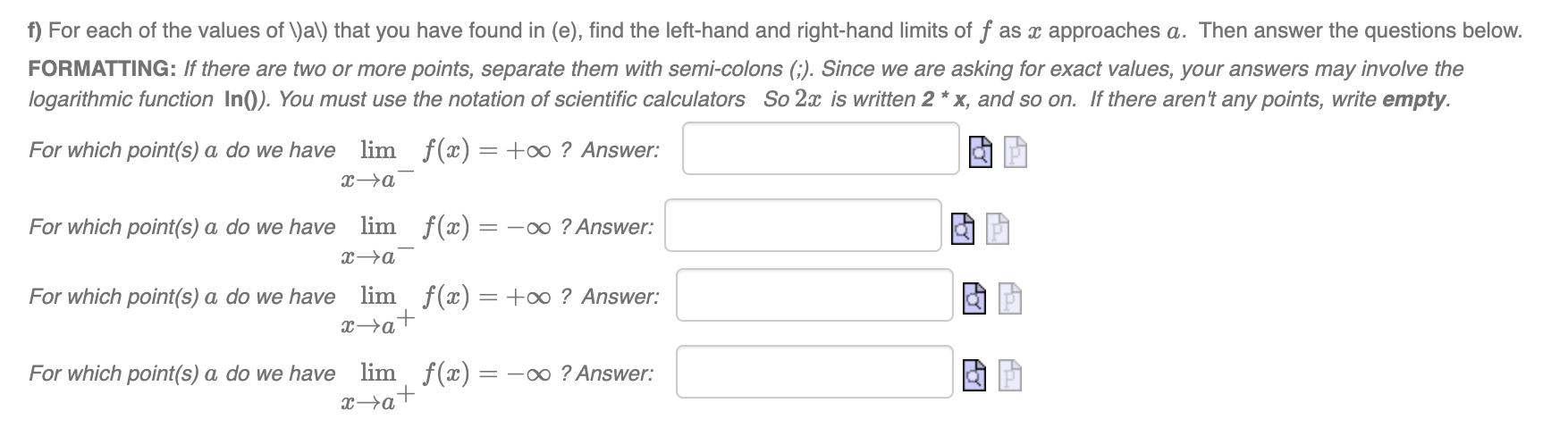
Consider the function f defined by f(x) its domain. a) First compute lim f(x). Answer: 4/5 H4X 4+5e e-3x 5-16e-3x and Q(x)? FORMATTING: b) Next we want to compute the limit in the opposite direction. As a goes to -oo, we get an indeterminate form of the type O 0 x O 1% - O 0 0/0 O 0/0 . Our goal in this question is to understand its behaviour as a goes to too, as well as near gaps in c) To be able to compute lim f(x), you have to rewrite f(x) as a fraction f(x) x118 BE d) Using your answer in (c), compute lim f(x). Answer: 5/-16 H118 Finally, we analyse f(x) near gaps in its domain. e) Find the point(s) a= a where f(a) is undefined. Answer: = Write your answer in the form [P(x), Q(x)], including the square brackets and comma. Simplify so there are no fractional expressions in the numerator P(x) or denominator Q(x). Strict calculator notation is required in your answer, meaning for multiplication (e.g. 3x is written 3*x, and e3 is written e^(3*x)). Answer: [P(x), Q(x)] = BA P(x) Q(x) that is no longer an indeterminate form. What are P(x) FORMATTING: List these points. If there are two or more such points, you must separate them by semi-colons (;). Since we are asking for exact values, your answers may involve the logarithm function In(). & f) For each of the values of \a\) that you have found in (e), find the left-hand and right-hand limits of f as x approaches a. Then answer the questions below. FORMATTING: If there are two or more points, separate them with semi-colons (;). Since we are asking for exact values, your answers may involve the logarithmic function In()). You must use the notation of scientific calculators So 2x is written 2 * x, and so on. If there aren't any points, write empty. For which point(s) a do we have lim f(x) = +o ? Answer: xa For which point(s) a do we have lim f(x) = = ? Answer: xa For which point(s) a do we have lim f(x) = +o? Answer: xa+ For which point(s) a do we have lim f(x)= = - ? Answer: xa+ Po AZ
Step by Step Solution
3.45 Rating (152 Votes )
There are 3 Steps involved in it
Analysis 3x dx xx3y 6y dy 0 Let R 2 y 3xY and Sx x x 3y by This is an exac differ... View full answer

Get step-by-step solutions from verified subject matter experts
 Study Help