







Question: Consider the function f whose graph is shown below: This function is given by (a) Find a formula for the single variable function f(0, y).
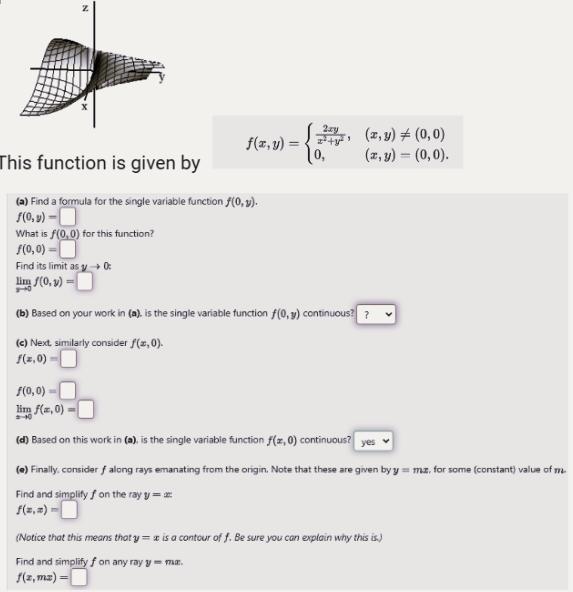
This function is given by (a) Find a formula for the single variable function f(0, y). f(0, 9) - What is f(0,0) for this function? f(0,0) Find its limit as y 0 lim f(0, 1) - f(x, y) = + (x, y) = (0,0) {(2,3) 0, (x, y) = (0,0). (b) Based on your work in (a), is the single variable function f(0, 3) continuous?? (c) Next, similarly consider f(z,0). f(z,0) - f(0,0). lim f(a,0) (d) Based on this work in (a), is the single variable function f(x,0) continuous? (e) Finally, consider falong rays emanating from the origin. Note that these are given by y=mz, for some (constant) value of m. Find and simplify fon the ray y = f(z. a) - B (Notice that this means that y=x is a contour off. Be sure you can explain why this is.) Find and simplify fon any ray yma. f(z, mz) -
Step by Step Solution
There are 3 Steps involved in it
fx y 2xy xy 0 f04 20y 0y 00 0 As f040 YER lim f0 y 0 f x0 220 f04 in continuous at y0 As lim ... View full answer

Get step-by-step solutions from verified subject matter experts
 Study Help