







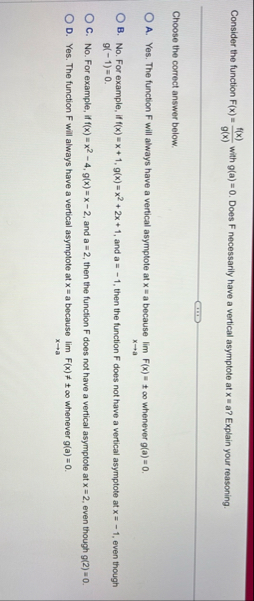
Question: Consider the function F ( x ) = f ( x ) g ( x ) with g ( a ) = 0 . Does
Consider the function with Does necessarily have a vertical asymptote at a Explain your reasoning.
Choose the correct answer below.
A Yes. The function will always have a vertical asymptote at a because whenever
B No For example, if and then the function does not have a vertical asymptote at even though
C No For example, if and then the function does not have a vertical asymptote at even though
D Yes. The function will always have a vertical asymptote at a because whenever
Step by Step Solution
There are 3 Steps involved in it
1 Expert Approved Answer
Step: 1 Unlock

Question Has Been Solved by an Expert!
Get step-by-step solutions from verified subject matter experts
Step: 2 Unlock
Step: 3 Unlock
 Study Help