







Question: Consider the function f(;c)=4si.n (% (ac3)) +8. State the amplitude A. period P. and midline. State the phase shift and vertical translation. In the full
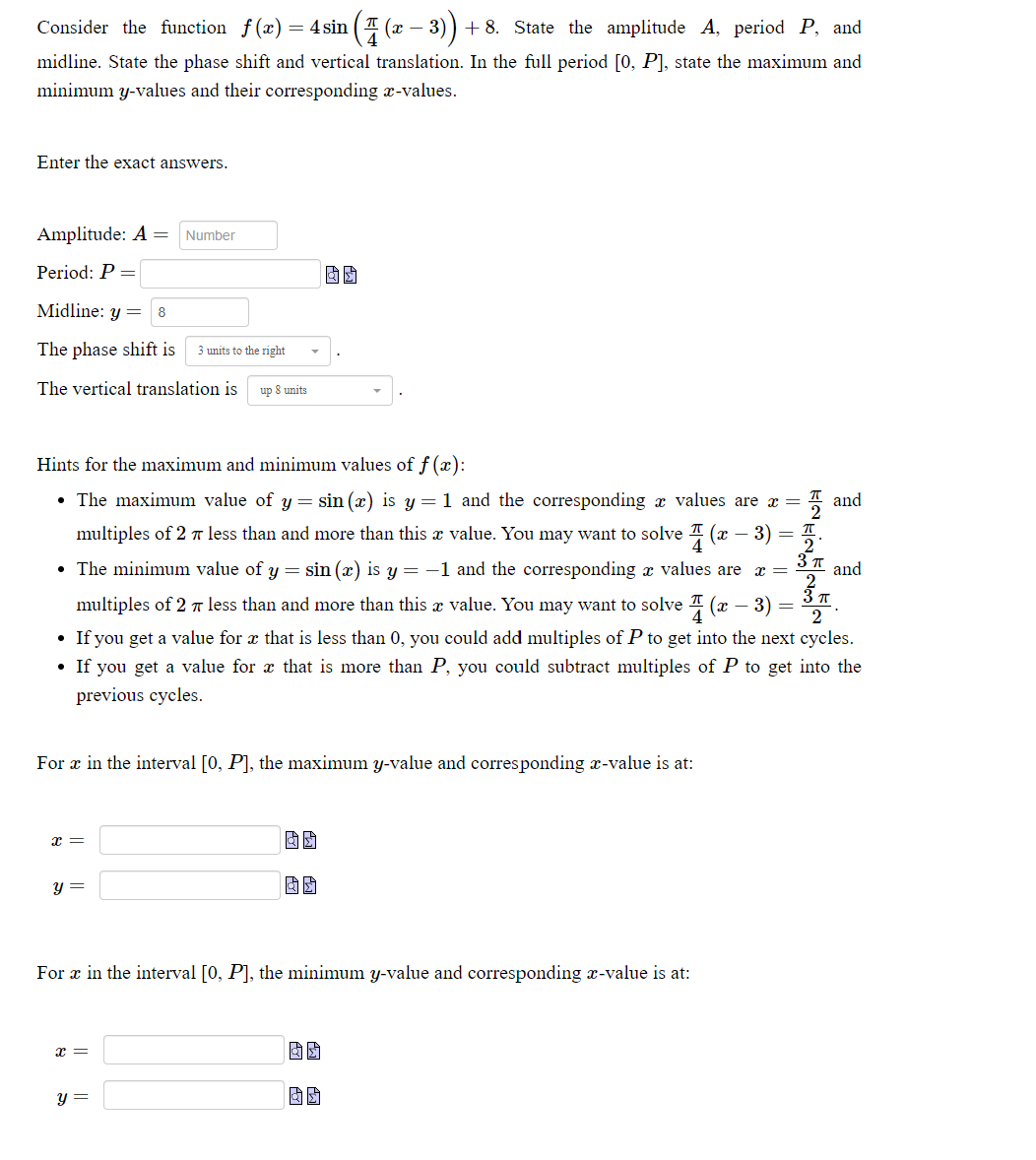
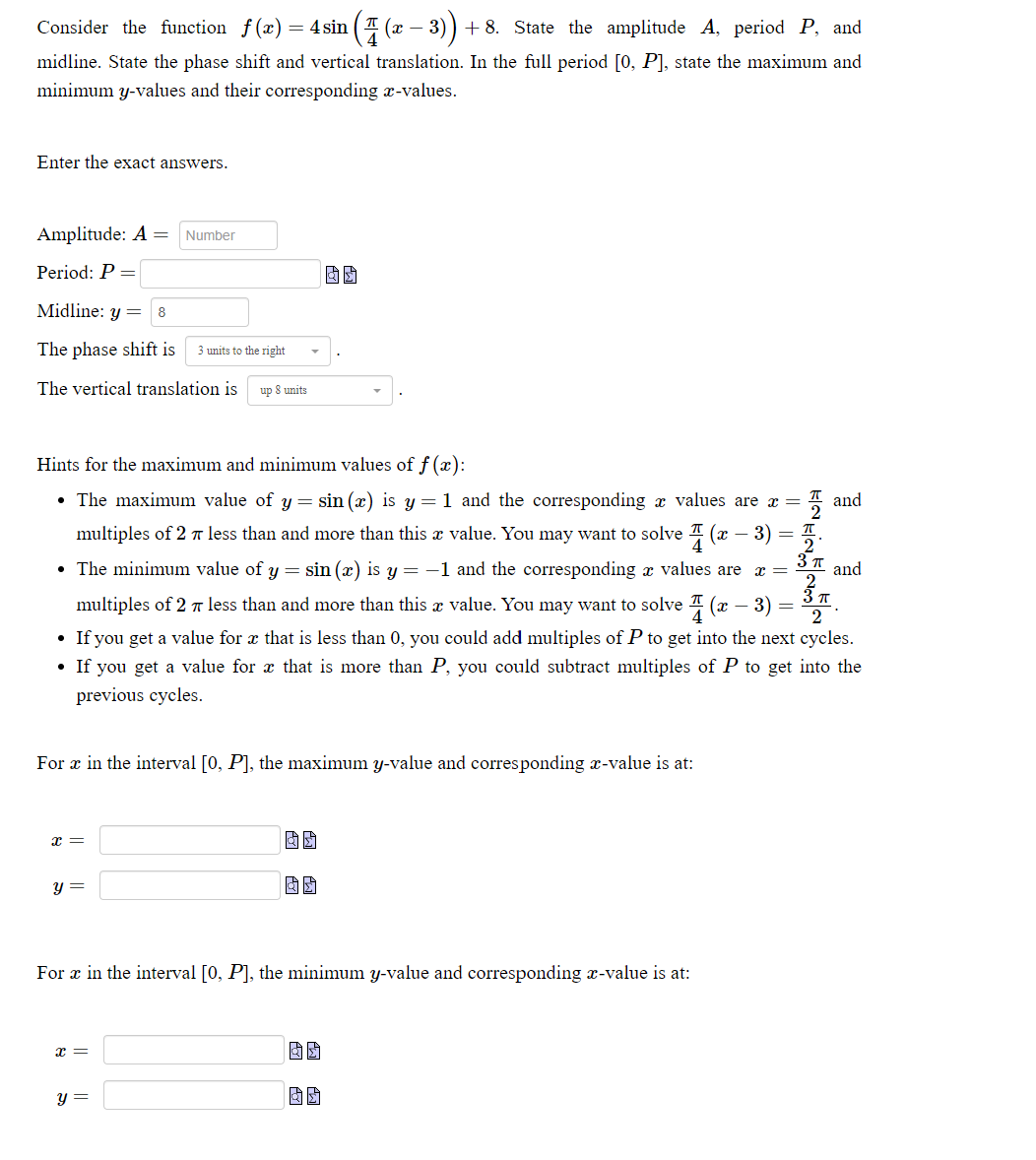
Consider the function f(;c)=4si.n (% (ac3)) +8. State the amplitude A. period P. and midline. State the phase shift and vertical translation. In the full period [0. P]. state the maximum and minimum yivalues and their corresponding 36452111165. Enter the exact answers. Amplitude: A : Period: P = Q @ Midline: y = 8 The phase shift is 3mr.=':t.he:ighl The vertical translation is -.;E-.-:.m Hints for the maximum and minimum values of f (:13): I The maximum value of y : sin (:12) is y : 1 and the corresponding 2: values are m : g and multiples of 2 1r less than and more than this a value. You may want to solve E (a: 3) = g. - The minimum value ofy = sin [x] is y = 1 and the corresponding at values are so = 3 a' and 2 multiples of 2 1r less than and more rhan this a value. You may want to solve E (a: 3) = 3. 4 c If you get a value for x that is less than 0. you could add multiples ofP to get into the next cycles. I If you get a value for x that is more than P. you could subtract multiples of P to get into the previou 5 cycles. For :5 in the interval [0. P]. the maximum yvalue and corresponding :avalue is at
Step by Step Solution
There are 3 Steps involved in it

Get step-by-step solutions from verified subject matter experts
 Study Help