





Question: Consider the function g : R^3 ? R defined by g(x, y, z) = x^2 + 2y^2 ? z^a , where the natural number a
Consider the function g : R^3 ? R defined by g(x, y, z) = x^2 + 2y^2 ? z^a , where the natural number a satisfies a ? 2
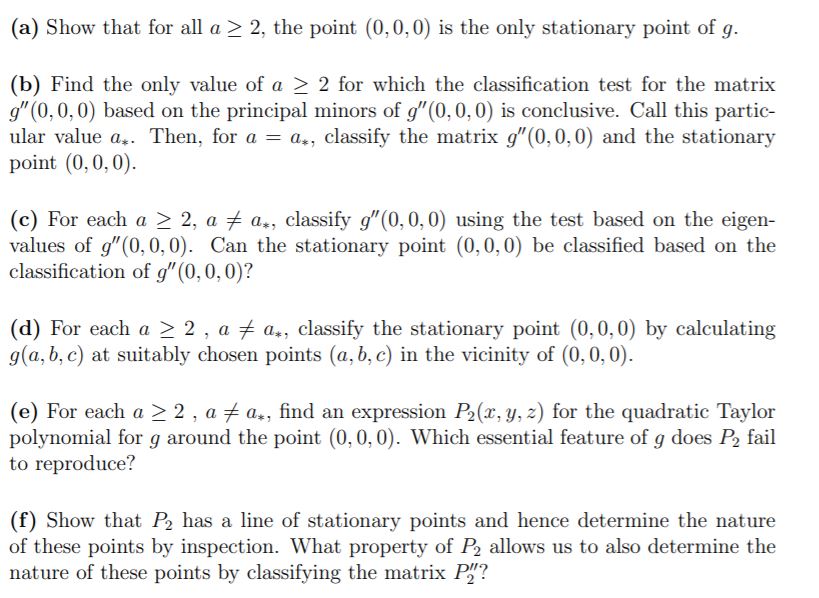
(a) Show that for all e 2 2, the point (0,0,0) is the only stationary point of g. (b) Find the only value of a 2 2 for which the classication test for the matrix 9\" (0, 0, 0) based on the principal minors of g\"(0, 0, 0) is conclusive. Call this partic- ular value on. Then, for a = (1,, classify the matrix g\"(0,0,0) and the stationary point (0,0,0). (c) For each a 2 2, a 79 (1., classify g\"(0,0, 0) using the test based on the eigen- values of g\"(0, 0,0). Can the stationary point (0, 0, 0) be classied based on the classication of 9"(0, 0, 0)? (d) For each a Z 2 , o 7!! (1*, classify the stationary point (0,0,0) by calculating g(o,b, c) at suitably chosen points (a, b,(:) in the vicinity of (0, 0,0). (e) For each a Z 2 , (1 7E (1,, nd an expression P2(:r,y,z) for the quadratic Taylor polynomial for 9 around the point (0,0, 0). Which essential feature of 9 does P2 fail to reproduce? (1') Show that P2 has a line of stationary points and hence determine the nature of these points by inspection. What property of P2 allows us to also determine the nature of these points by classifying the matrix Rf

