







Question: Consider the function Magic, whose pseudocode is illustrated in Algorithm 1. The algorithm takes a graph as an input and outputs either true or false.
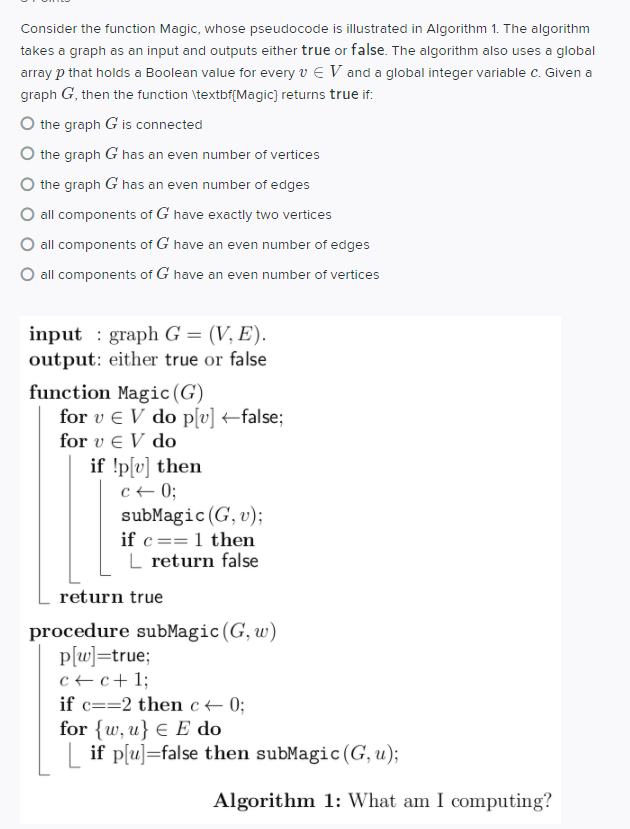
Consider the function Magic, whose pseudocode is illustrated in Algorithm 1. The algorithm takes a graph as an input and outputs either true or false. The algorithm also uses a global array p that holds a Boolean value for every v EV and a global integer variable C. Given a graph G, then the function \textbf[Magic) returns true if: the graph G is connected the graph G has an even number of vertices the graph G has an even number of edges all components of G have exactly two vertices all components of G have an even number of edges all components of G have an even number of vertices input : graph G = (V, E). output: either true or false function Magic (G) for v V do p[u] false; for v EV do if !p[u] then C+0; subMagic(G,v); if c==1 then L return false return true procedure subMagic (G, w) p[w]=true; ct c+1; if c==2 then c+ 0; for {w, u} e E do if p[u]=false then subMagic(G,u); Algorithm 1: What am I computing
Step by Step Solution
There are 3 Steps involved in it

Get step-by-step solutions from verified subject matter experts
 Study Help