







Question: Consider the Gamma function, the function of a defined by using a as a constant in an integral as follows: I(x) = This definition
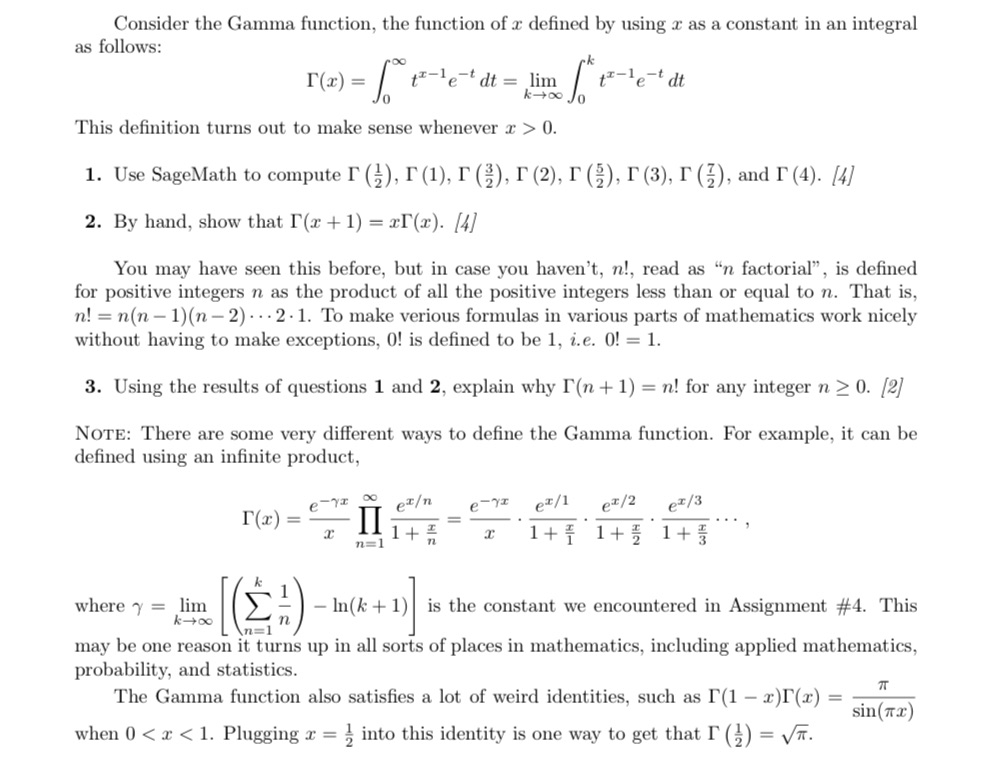
Consider the Gamma function, the function of a defined by using a as a constant in an integral as follows: I(x) = This definition turns out to make sense whenever x > 0. I(x) where y = lim 1. Use SageMath to compute I (1), r (1), r (2), I (2), I (), I (3), I (1), and I (4). [4] r 2. By hand, show that I'(x + 1) xr(x). [4] e-7x You may have seen this before, but in case you haven't, n!, read as "n factorial", is defined for positive integers n as the product of all the positive integers less than or equal to n. That is, n! = n(n-1)(n-2) 2.1. To make verious formulas in various parts of mathematics work nicely without having to make exceptions, 0! is defined to be 1, i.e. 0! = 1. 3. Using the results of questions 1 and 2, explain why I'(n + 1) = n! for any integer n 0. [2] NOTE: There are some very different ways to define the Gamma function. For example, it can be defined using an infinite product, x tz-le-t dt = lim II n=1 ex/n 1 x+y 72 = t-le-t dt -YI ex/1 ex/2 ex/3 x 1+1 1+1+ k * ( ( ) 1 ( + 1] =1 may be one reason it turns up in all sorts of places in mathematics, including applied mathematics, probability, and statistics. The Gamma function also satisfies a lot of weird identities, such as I(1-x)(x) = when 0
Step by Step Solution
There are 3 Steps involved in it

Get step-by-step solutions from verified subject matter experts
 Study Help