







Question: Consider the general Solow growth model. Suppose production function at time t is described as: K = K. (14.1%) where Yt is aggregate output, Kt
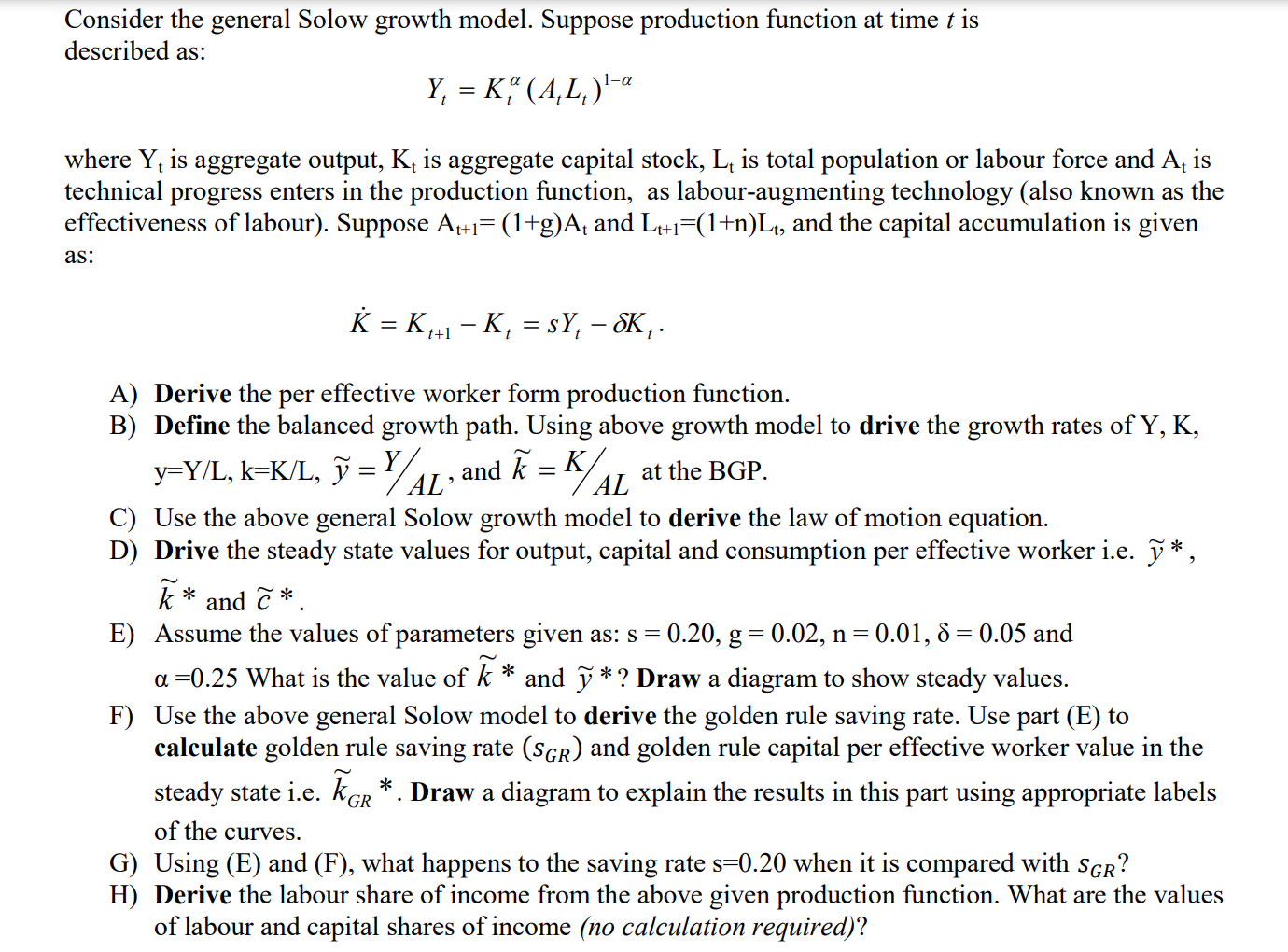
Consider the general Solow growth model. Suppose production function at time t is described as: K = K.\" (14.1%)\" where Yt is aggregate output, Kt is aggregate capital stock, Lt is total population or labour force and AI is technical progress enters in the production function, as labour-augmenting technology (also known as the effectiveness of labour). Suppose At+1= (1+g)i'31t and Lt+1=(l+n)Lt, and the capital accumulation is given as: K=K,,1K,=SY, K,. A) Derive the per effective worker form production function. B) Dene the balanced growth path. Using above growth model to drive the growth rates of Y, K, y=Y/L, k=K/L, 57 = V411, and I? = 5%, L at the BGP. C) Use the above general Solow growth model to derive the law of motion equation. D) Drive the steady state values for output, capital and consumption per effective worker i.e. y * , i5 * and E *. E) Assume the values ofparameters given as: s = 0.20, g = 0.02, n = 0.01, 5 = 0.05 and or =0.25 What is the value of k * and f * ? Draw a diagram to show steady values. F) Use the above general Solow model to derive the golden rule saving rate. Use part (B) to calculate golden rule saving rate (36R) and golden rule capital per effective worker value in the steady state i.e. kGR * . Draw a diagram to explain the results in this part using appropriate labels of the curves. G) Using (E) and (F), what happens to the saving rate s=0.20 when it is compared with 36R? H) Derive the labour share of income from the above given production Jnction. What are the values of labour and capital shares of income (no calculation required)
Step by Step Solution
There are 3 Steps involved in it

Get step-by-step solutions from verified subject matter experts
 Study Help