







Question: Consider the given data set. n = 12 measurements:7, 8, 1, 3, 5, 7, 3, 6, 8, 5, 4, 0 Find the mean. 23. +
Consider the given data set.
n= 12
measurements:7, 8, 1, 3, 5, 7, 3, 6, 8, 5, 4, 0
Find the mean.
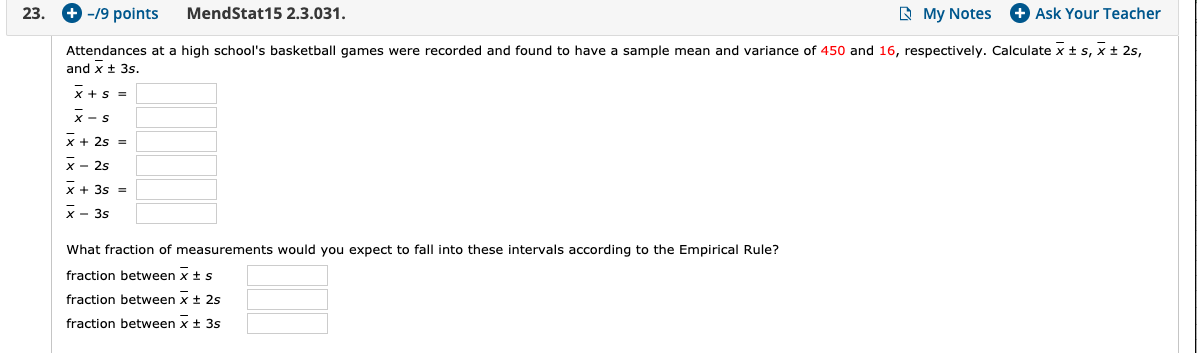
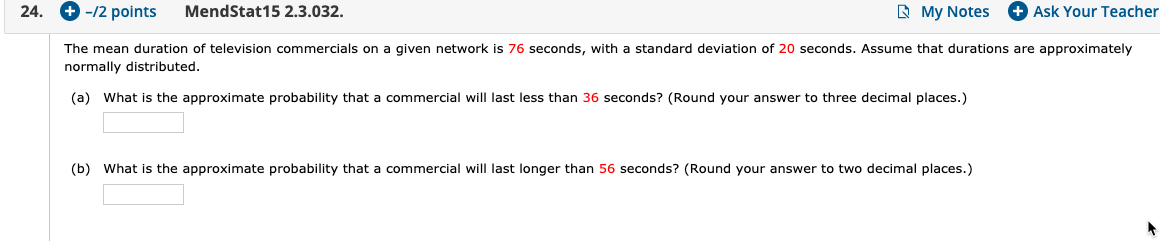
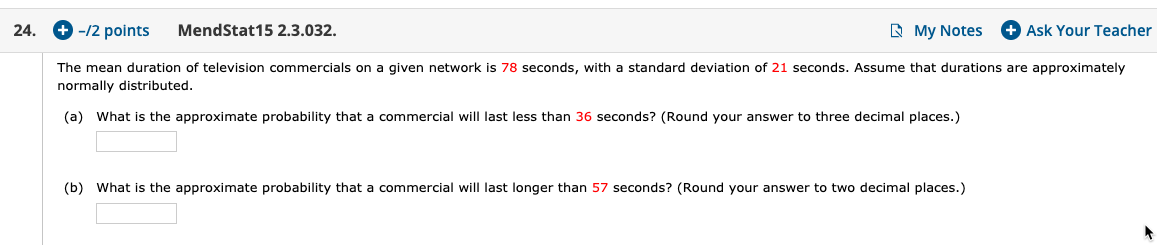
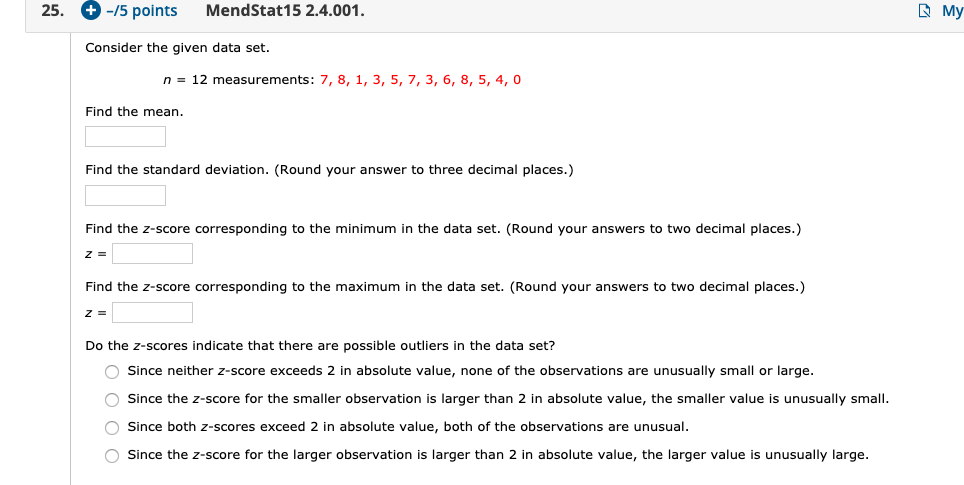
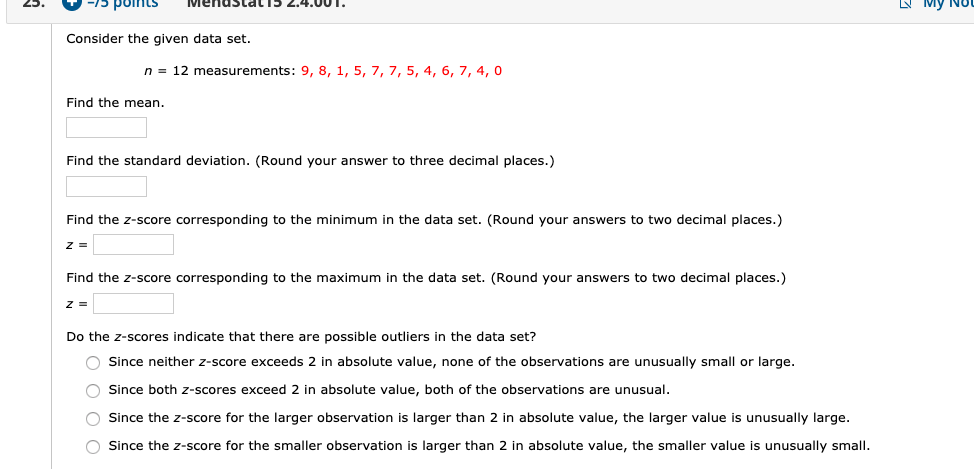
23. + -/9 points MendStat15 2.3.031. My Notes + Ask Your Teacher Attendances at a high school's basketball games were recorded and found to have a sample mean and variance of 450 and 16, respectively. Calculate x + s, x + 2s, and x + 3s. x +5 = x - S x + 25 x - 2s x + 3s = x - 35 What fraction of measurements would you expect to fall into these intervals according to the Empirical Rule? fraction between x + s fraction between x + 2s fraction between x + 3s24. o 42 points MendStat15 2.3.032. I} My Notes 0 Ask Your Teacher The mean duration of television commercials on a given network Is 76 seconds, with a standard deviation of 20 seconds. Aume that durations are approximately normally distributed. (a) What is the approximate probability that a commercial will last less than 36 seconds? (Round your answer to three decimal places.) (b) What is the approximate probability that a commercial will last longer than 55 seconds? (Round your answer to two decimal places.) 24. o 42 points MendStat15 2.3.032. I} My Notes 0 Ask Your Teacher The mean duration of television commercials on a given network is 78 seconds, with a standard deviation of 21 seconds. Aume that durations are approximately normally distributed. (a) What is the approximate probability that a commercial will last less than 36 seconds? (Round your answer to three decimal places.) (b) What is the approximate probability that a commercial will last longer than 57 seconds? (Round your answer to two decimal places.) 25. o -15 points MendStat15 2.4.001. Consider the given data set. 11 - 12 measurements: 7, B. l, 3. 5, 3", 3, 6, B. 5, 4. 0 Find the mean. Find the standard deviation. (Round your answer to three decimal places.) Find the z-score corresponding to the minimum In the data set. (Round your answers to two decimal places.) 2- Find the z-score corresponding to the maximum in the data set. (Round your answers to two decimal places.) 2- Do the z-scores indicate that there are possible outliers in the data set? ('3 Since neither z-score exceeds 2 in absolute value, none of the observations are unusually small or large. \ (W Since the z-score for the smaller observation is larger than 2 in absolute value, the smaller value is unusually small. \ (W Since both z-scores exceed 2 In absolute value, both of the observations are unusual. \\/ Since the z-score for the larger observation is larger than 2 in absolute value, the larger value is unusually large. \\/ QM}; 3. u '33 Pullllb menuauu. I3 .H.W I. bl My I'IUI Consider the given data set. I": - 12 measurements: 9, B. 1, 5. ?, Ir', 5, 4, 6. 3', 4. 0 Find the mean . Find the standard deviation. (Round your answer to three decimal places.) Find the z-score corresponding to the minimum In the data set. (Round your answers to two decimal places.) 2- Find the z-score corresponding to the maximum in the data set. (Round your answers tJo two decimal places.) 2- Do the z-scores Indicate that there are possible outliers In the data set? N Since neither z-score exceeds 2 In absolute value, none of the observations are unusually small or large. \\x N Since both z-scores exceed 2 in absolute value, both of the observations are unusual. \\( Since the z-score for the larger observation is larger than 2 In absolute value, the larger value Is unusually large. \\x N Since the z-score for the smaller observation Is larger than 2 in absolute value, the smaller value is unusually small. \\(
Step by Step Solution
There are 3 Steps involved in it

Get step-by-step solutions from verified subject matter experts
 Study Help