







Question: Consider the graph. Note that estimated costs are given in brackets next to each node (e.g., A=[15]), while actual costs are given in plain text
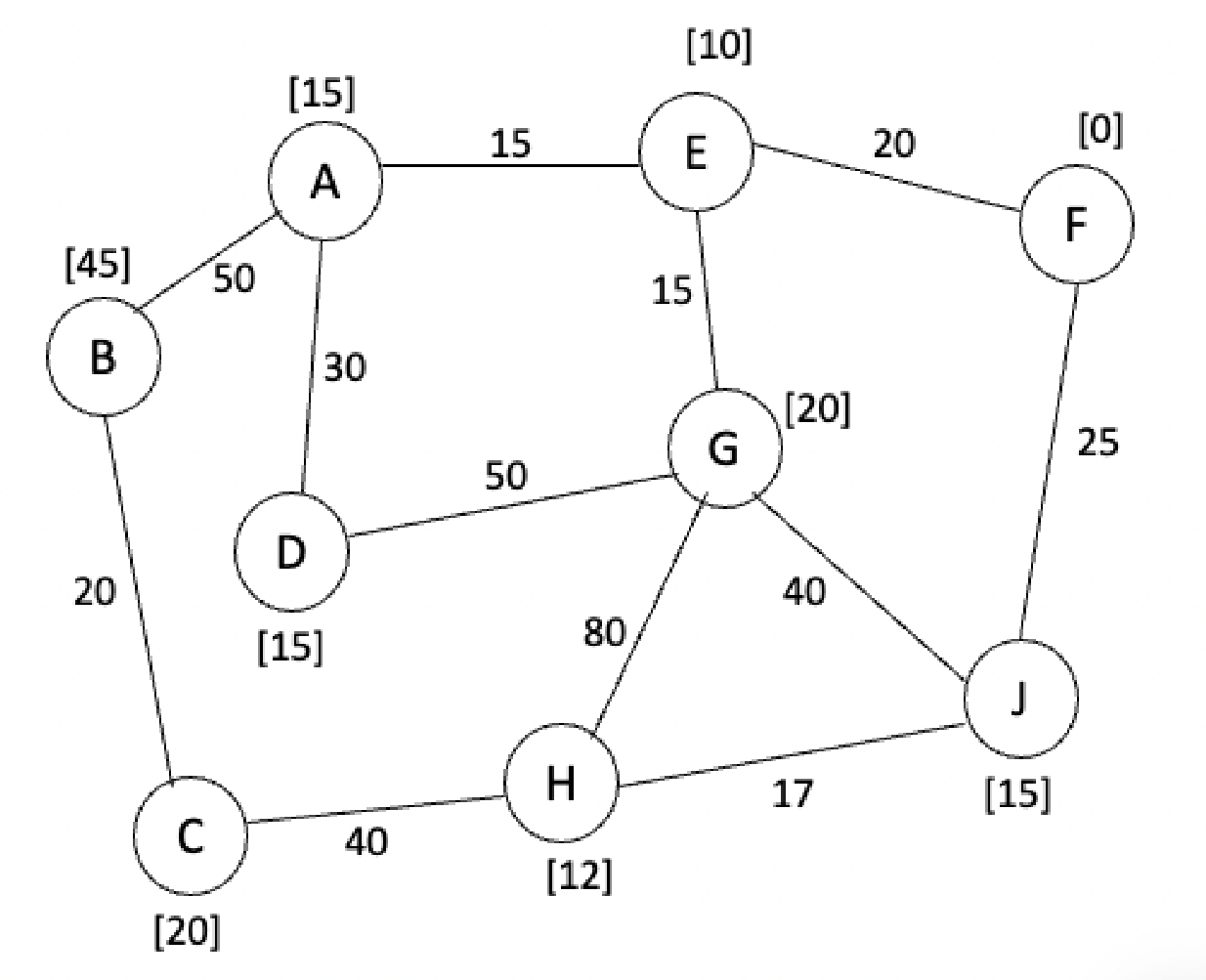
Consider the graph.
Note that estimated costs are given in brackets next to each node (e.g., A=[15]), while actual costs are given in plain text as the label of each edge (e.g., A->B = 50).
There are three starting nodes, namely "A", "B" and "C", and one finish node, namely "F". Apply greedy best-first search in order to move from each starting node ("A", "B" and "C") to the same finish node ("F"), namely find the paths from "A" to "F", from "B" to "F", and from "C" to "F". If multiple alternative nodes are available at any step, your choice should be based on alphabetical order. For each starting point ("A", "B" and "C"), provide: a) The computed path showing the order in which every node is visited b) The total cost of the computed path c) A tree search at each step justifying each expansion.
[10] [20]
Step by Step Solution
There are 3 Steps involved in it

Get step-by-step solutions from verified subject matter experts
 Study Help