







Question: Consider the Hotelling model as seen at class. That is, there is a linear city of length 1, with two firms, each one located
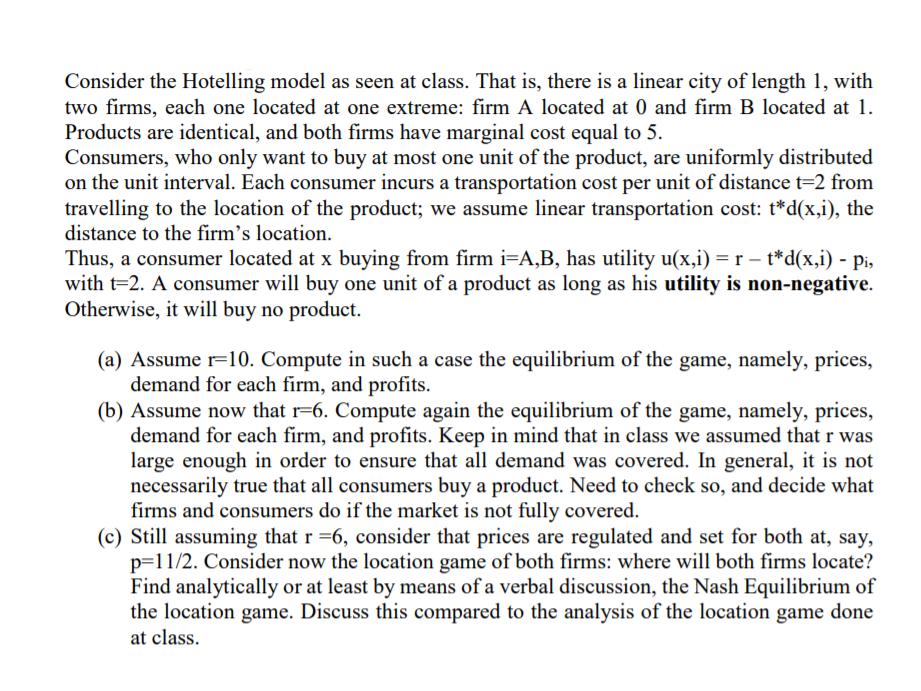
Consider the Hotelling model as seen at class. That is, there is a linear city of length 1, with two firms, each one located at one extreme: firm A located at 0 and firm B located at 1. Products are identical, and both firms have marginal cost equal to 5. Consumers, who only want to buy at most one unit of the product, are uniformly distributed on the unit interval. Each consumer incurs a transportation cost per unit of distance t=2 from travelling to the location of the product; we assume linear transportation cost: t*d(x,i), the distance to the firm's location. Thus, a consumer located at x buying from firm i-A,B, has utility u(x,i) = r t*d(x,i) - Pi, with t=2. A consumer will buy one unit of a product as long as his utility is non-negative. Otherwise, it will buy no product. (a) Assume r-10. Compute in such a case the equilibrium of the game, namely, prices, demand for each firm, and profits. (b) Assume now that r-6. Compute again the equilibrium of the game, namely, prices, demand for each firm, and profits. Keep in mind that in class we assumed that r was large enough in order to ensure that all demand was covered. In general, it is not necessarily true that all consumers buy a product. Need to check so, and decide what firms and consumers do if the market is not fully covered. (c) Still assuming that r =6, consider that prices are regulated and set for both at, say, p=11/2. Consider now the location game of both firms: where will both firms locate? Find analytically or at least by means of a verbal discussion, the Nash Equilibrium of the location game. Discuss this compared to the analysis of the location game done at class.
Step by Step Solution
3.49 Rating (179 Votes )
There are 3 Steps involved in it
a With r10 the consumers utility is nonnegative for all x so all consumers wi... View full answer

Get step-by-step solutions from verified subject matter experts
 Study Help