





Question: Consider the information cascade model. There are two possible states of the world, Y and N, which are equally likely. Agents A, B and C
Consider the information cascade model. There are
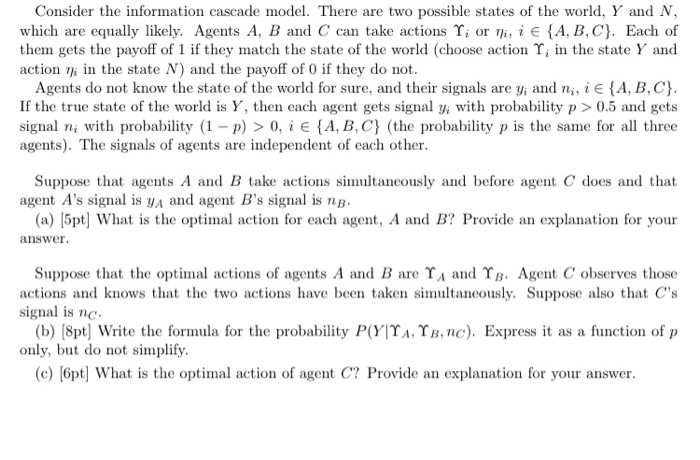
Consider the information cascade model. There are two possible states of the world, Y and N, which are equally likely. Agents A, B and C can take actions T, or Nii {A, B, C). Each of them gets the payoff of 1 if they match the state of the world (choose action T, in the state Y and action ni in the state N) and the payoff of 0 if they do not. Agents do not know the state of the world for sure, and their signals are y; and ni, i c{A,B,C). If the true state of the world is Y, then each agent gets signal yi with probability p > 0.5 and gets signal ni with probability (1 - p) > 0, 1 {A,B,C) (the probability p is the same for all three agents). The signals of agents are independent of each other. Suppose that agents A and B take actions simultaneously and before agent C does and that agent A's signal is yA and agent B's signal is nb. (a) [5pt] What is the optimal action for each agent, A and B? Provide an explanation for your answer. Suppose that the optimal actions of agents A and B are r A and YB. Agent C observes those actions and knows that the two actions have been taken simultaneously. Suppose also that C's signal is no (b) (8pt] Write the formula for the probability P(Y|TA, TB, nC). Express it as a function of p only, but do not simplify. (c) (6pt] What is the optimal action of agent C? Provide an explanation for your

Step by Step Solution

There are 3 Steps involved in it

1 Expert Approved Answer
Step: 1 Unlock blur-text-image

Question Has Been Solved by an Expert!

Get step-by-step solutions from verified subject matter experts

Step: 2 Unlock
Step: 3 Unlock

Students Have Also Explored These Related General Management Questions!