







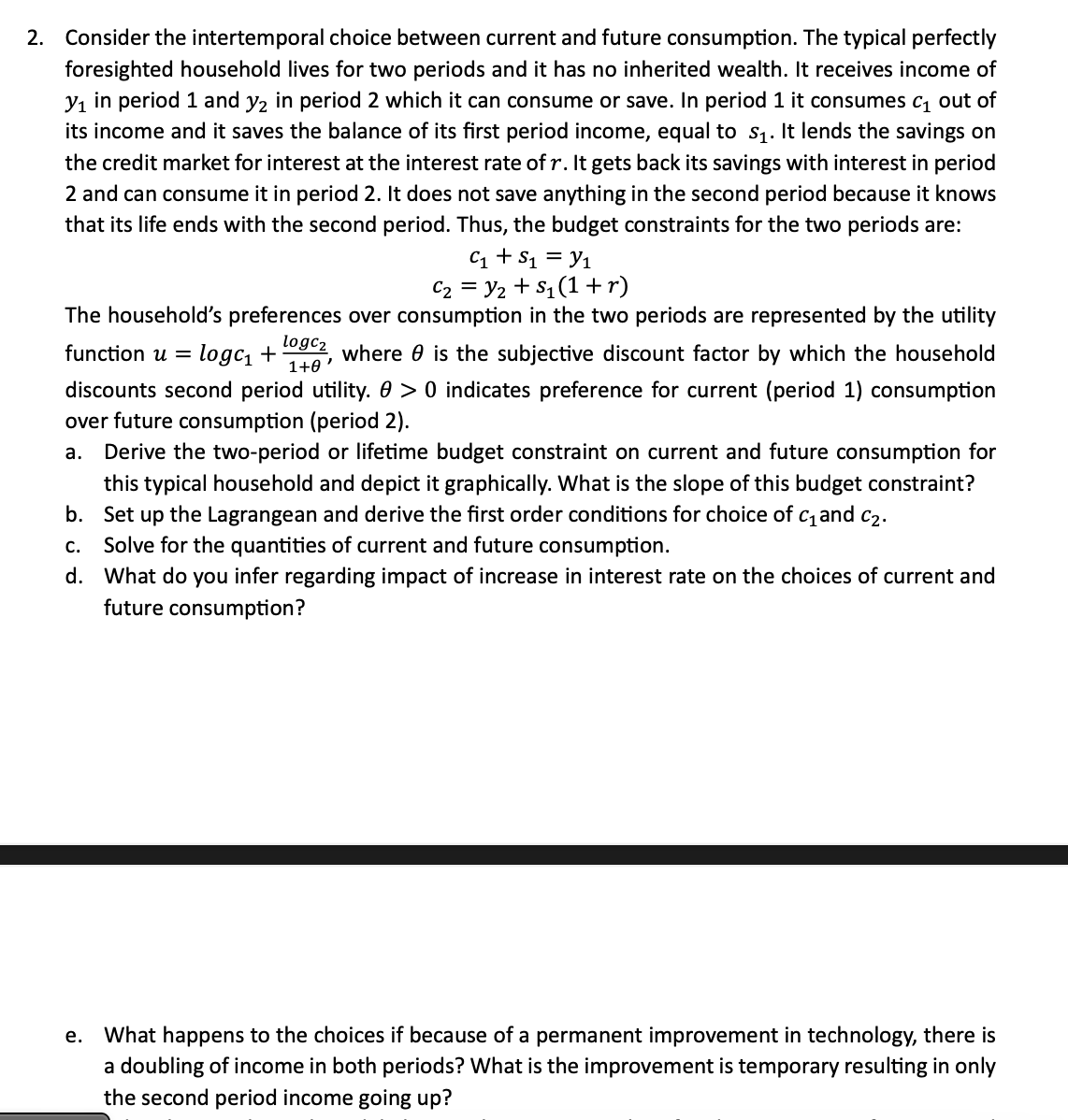
Question: Consider the intertemporal choice between current and future consumption. The typical perfectly foresighted household lives for two periods and i t has n o inherited
Consider the intertemporal choice between current and future consumption. The typical perfectly
foresighted household lives for two periods and has inherited wealth. receives income
period and period which can consume save. period consumes out
its income and saves the balance its first period income, equal lends the savings
the credit market for interest the interest rate gets back its savings with interest period
and can consume period does not save anything the second period because knows
that its life ends with the second period. Thus, the budget constraints for the two periods are:
The household's preferences over consumption the two periods are represented the utility
function where the subjective discount factor which the household
discounts second period utility. indicates preference for current consumption
over future consumption
Derive the twoperiod lifetime budget constraint current and future consumption for
this typical household and depict graphically. What the slope this budget constraint?
Set the Lagrangean and derive the first order conditions for choice and
Solve for the quantities current and future consumption.
What you infer regarding impact increase interest rate the choices current and
future consumption?
What happens the choices because a permanent improvement technology, there
a doubling income both periods? What the improvement temporary resulting only
the second period income going
Step by Step Solution
There are 3 Steps involved in it
1 Expert Approved Answer
Step: 1 Unlock

Question Has Been Solved by an Expert!
Get step-by-step solutions from verified subject matter experts
Step: 2 Unlock
Step: 3 Unlock
 Study Help