







Question: Consider the interval scheduling problem we discussed in class: given a set S = {1, 2, .. ., n} of activities, each activity i has
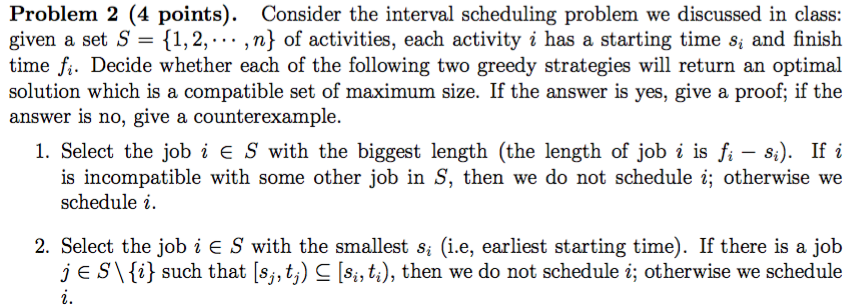
Consider the interval scheduling problem we discussed in class: given a set S = {1, 2, .. ., n} of activities, each activity i has a starting time s_i and finish time f_i. Decide whether each of the following two greedy strategies will return an optimal solution which is a compatible set of maximum size. If the answer is yes, give a proof; if the answer is no, give a counterexample. Select the job i elementof S with the biggest length (the length of job i is f_i - s_i). If i is incompatible with some other job in S, then we do not schedule i; otherwise we schedule i. Select the job i elementof S with the smallest s_i (i.e, earliest starting time). If there is a job j elementof S \ {i} such that [s_i, t_j) subset [s_i, t_i), then we do not schedule i; otherwise we schedule i. Consider the interval scheduling problem we discussed in class: given a set S = {1, 2, .. ., n} of activities, each activity i has a starting time s_i and finish time f_i. Decide whether each of the following two greedy strategies will return an optimal solution which is a compatible set of maximum size. If the answer is yes, give a proof; if the answer is no, give a counterexample. Select the job i elementof S with the biggest length (the length of job i is f_i - s_i). If i is incompatible with some other job in S, then we do not schedule i; otherwise we schedule i. Select the job i elementof S with the smallest s_i (i.e, earliest starting time). If there is a job j elementof S \ {i} such that [s_i, t_j) subset [s_i, t_i), then we do not schedule i; otherwise we schedule
Step by Step Solution
There are 3 Steps involved in it

Get step-by-step solutions from verified subject matter experts
 Study Help