







Question: Consider the limiting values resulting from a basic PageRank Update rule (that is, one which does NOT use a scaling factor s). Recall that these
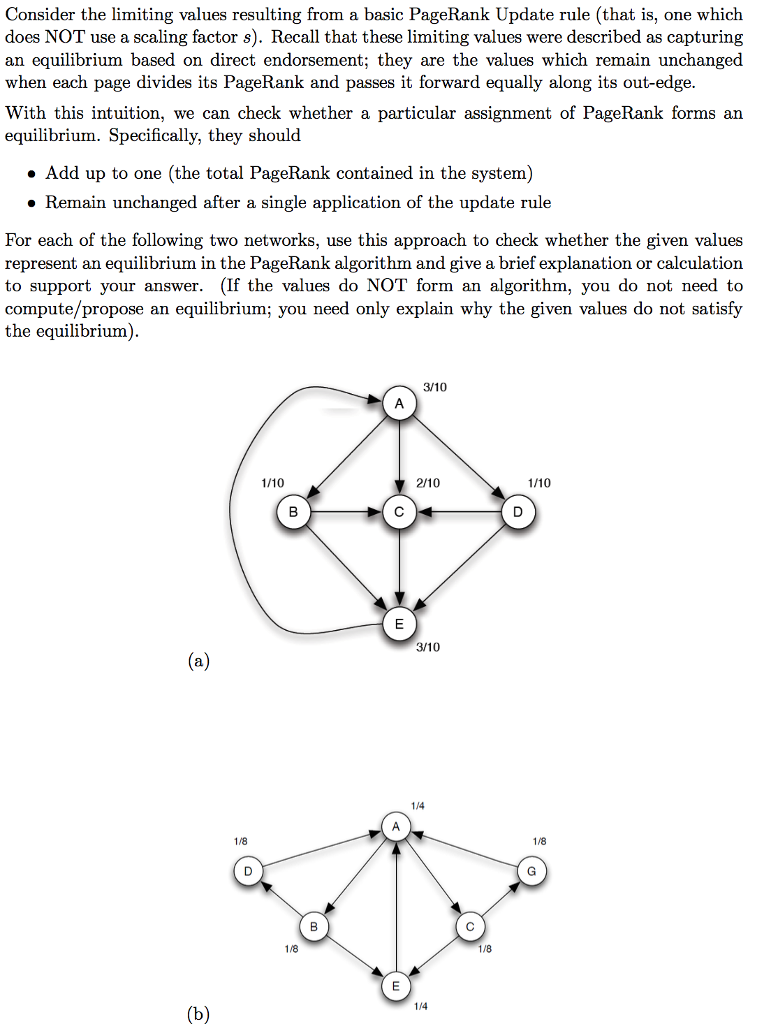
Consider the limiting values resulting from a basic PageRank Update rule (that is, one which does NOT use a scaling factor s). Recall that these limiting values were described as capturing an equilibrium based on direct endorsement; they are the values which remain unchanged when each page divides its PageRank and passes it forward equally along its out-edge With this intuition, we can check whether a particular assignment of PageRank forms an equilibrium. Specifically, they should Add up to one (the total PageRank contained in the system) Remain unchanged after a single application of the update rule For each of the following two networks, use this approach to check whether the given values represent an equilibrium in the PageRank algorithm and give a brief explanation or calculation to support your answer. (If the values do NOT form an algorithm, you do not need to compute/propose an equilibrium; you need only explain why the given values do not satisfy the equilibrium) 3/10 1/10 2/10 1/10 3/10 1/4 1/8 1/8 1/8 1/8 1/4 Consider the limiting values resulting from a basic PageRank Update rule (that is, one which does NOT use a scaling factor s). Recall that these limiting values were described as capturing an equilibrium based on direct endorsement; they are the values which remain unchanged when each page divides its PageRank and passes it forward equally along its out-edge With this intuition, we can check whether a particular assignment of PageRank forms an equilibrium. Specifically, they should Add up to one (the total PageRank contained in the system) Remain unchanged after a single application of the update rule For each of the following two networks, use this approach to check whether the given values represent an equilibrium in the PageRank algorithm and give a brief explanation or calculation to support your answer. (If the values do NOT form an algorithm, you do not need to compute/propose an equilibrium; you need only explain why the given values do not satisfy the equilibrium) 3/10 1/10 2/10 1/10 3/10 1/4 1/8 1/8 1/8 1/8 1/4
Step by Step Solution
There are 3 Steps involved in it

Get step-by-step solutions from verified subject matter experts
 Study Help