







Question: Consider the LTI linear system described by the state space equations: 0 1 -2 -3 y= ( -2 1 )x+u, (1) where u R is
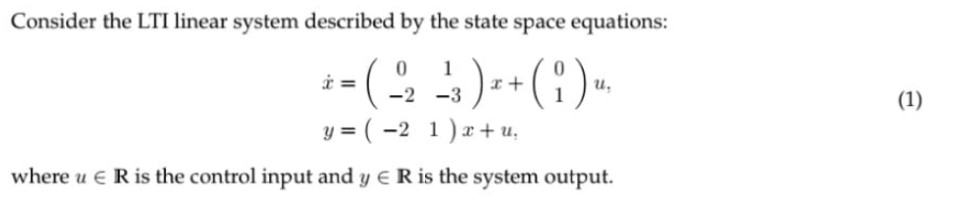
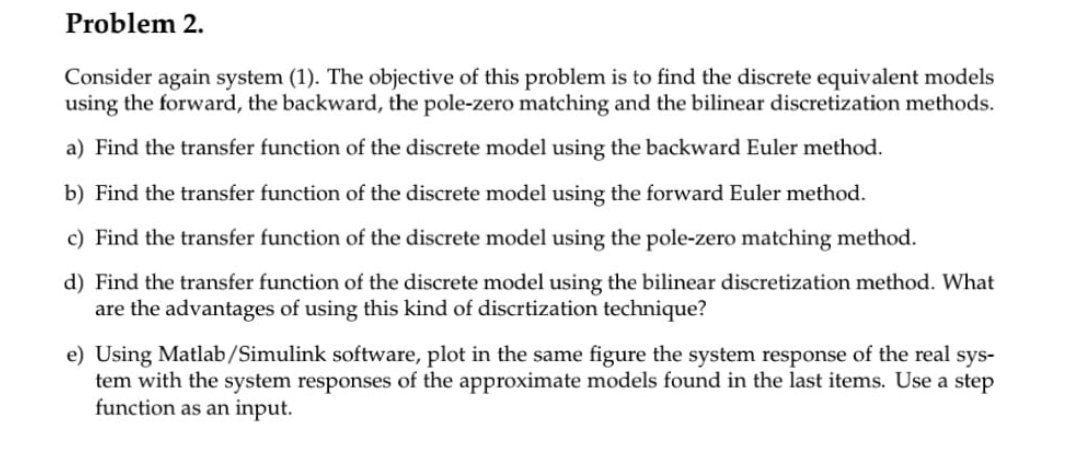
Consider the LTI linear system described by the state space equations: 0 1 -2 -3 y= ( -2 1 )x+u, (1) where u R is the control input and y E R is the system output. Problem 2. Consider again system (1). The objective of this problem is to find the discrete equivalent models using the forward, the backward, the pole-zero matching and the bilinear discretization methods. a) Find the transfer function of the discrete model using the backward Euler method. b) Find the transfer function of the discrete model using the forward Euler method. c) Find the transfer function of the discrete model using the pole-zero matching method. d) Find the transfer function of the discrete model using the bilinear discretization method. What are the advantages of using this kind of discrtization technique? e) Using Matlab/Simulink software, plot in the same figure the system response of the real sys- tem with the system responses of the approximate models found in the last items. Use a step function as an input. Consider the LTI linear system described by the state space equations: 0 1 -2 -3 y= ( -2 1 )x+u, (1) where u R is the control input and y E R is the system output. Problem 2. Consider again system (1). The objective of this problem is to find the discrete equivalent models using the forward, the backward, the pole-zero matching and the bilinear discretization methods. a) Find the transfer function of the discrete model using the backward Euler method. b) Find the transfer function of the discrete model using the forward Euler method. c) Find the transfer function of the discrete model using the pole-zero matching method. d) Find the transfer function of the discrete model using the bilinear discretization method. What are the advantages of using this kind of discrtization technique? e) Using Matlab/Simulink software, plot in the same figure the system response of the real sys- tem with the system responses of the approximate models found in the last items. Use a step function as an input
Step by Step Solution
There are 3 Steps involved in it

Get step-by-step solutions from verified subject matter experts
 Study Help