







Question: Question: For the exercise below you may perform the required I/O either by using system calls or by integrating your code with a C/C++ program.
Question:
For the exercise below you may perform the required I/O either by using system calls or by integrating your code with a C/C++ program. However, all of the actual work needs to be done in your assembly code. If, for example, you choose to do I/O in C++ I should see only calls to cout and cin. If you have questions about whether what you are doing is within the parameters of the assignment, ask.
Frequency tables are useful in data compression and other applications involving character processing. The Huffman encoding algorithm, for example, stores the more frequently occurring characters in fewer bits than other characters that occur less often.
Cre@te a program that constructs a character frequency table. Input to the program will be a user-generated string. You do not need to display the final table to the user. Hint: cre@te an array of 256 doublewords initialized to all zeros. Each array position is indexed by its corresponding ASCII code. When the procedure returns, each entry in the array contains a count of how many times the corresponding character occurred in the string.
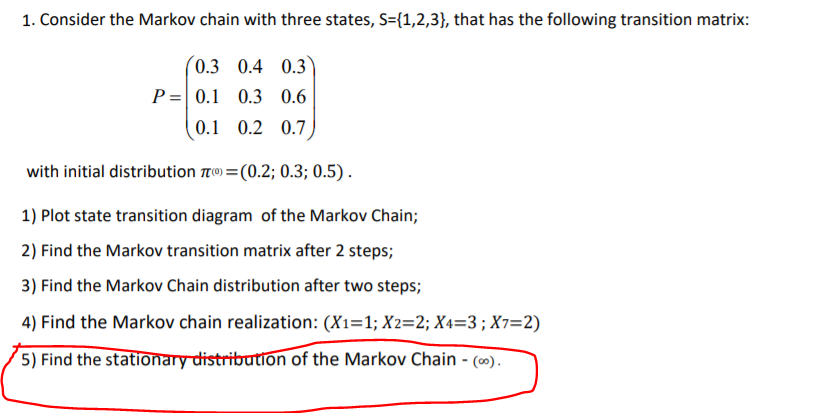
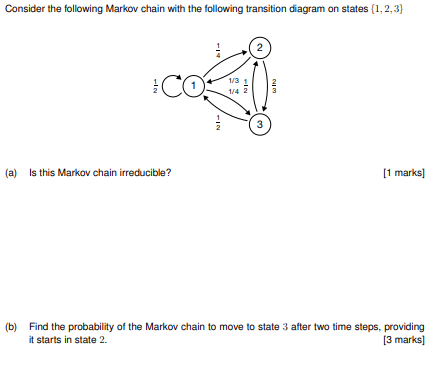
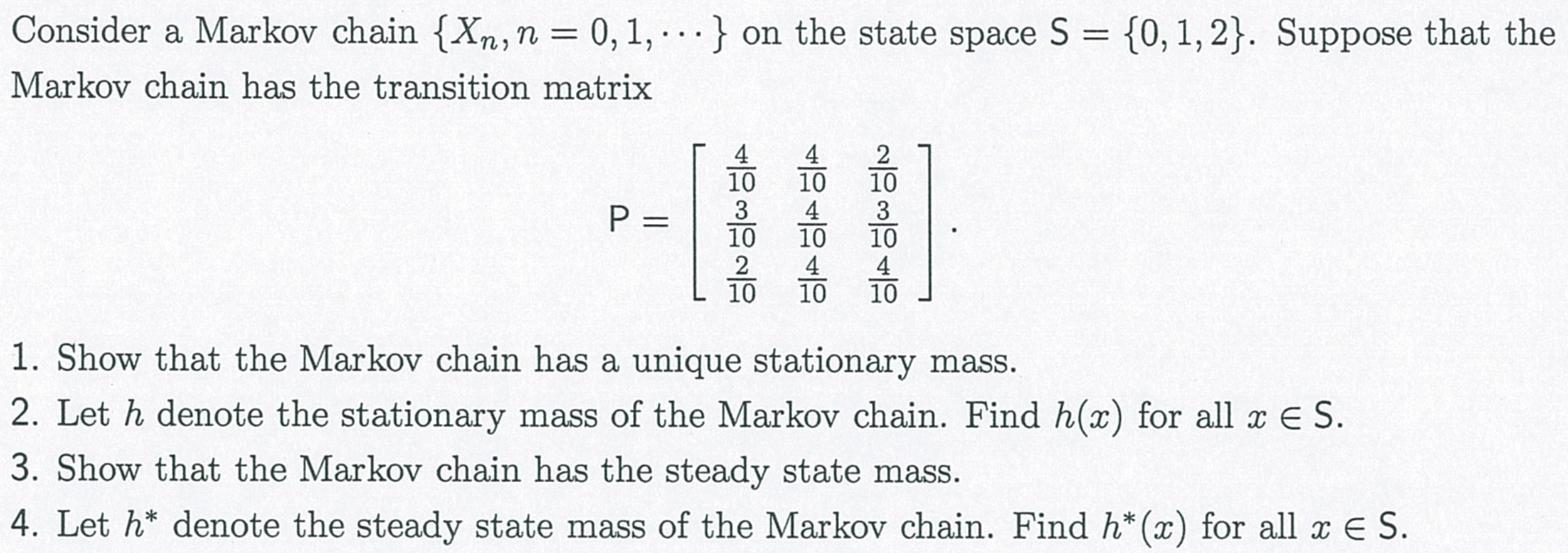
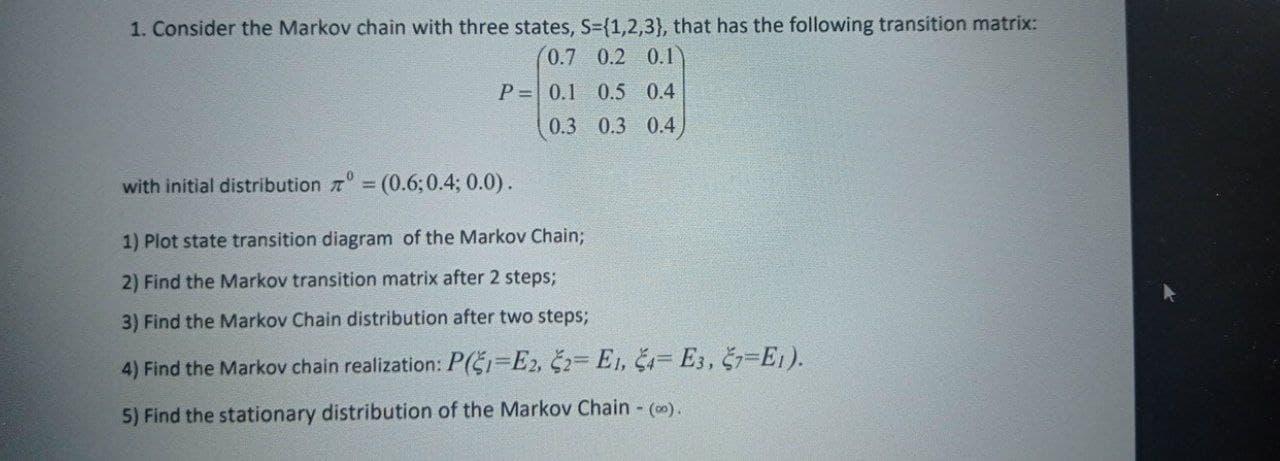
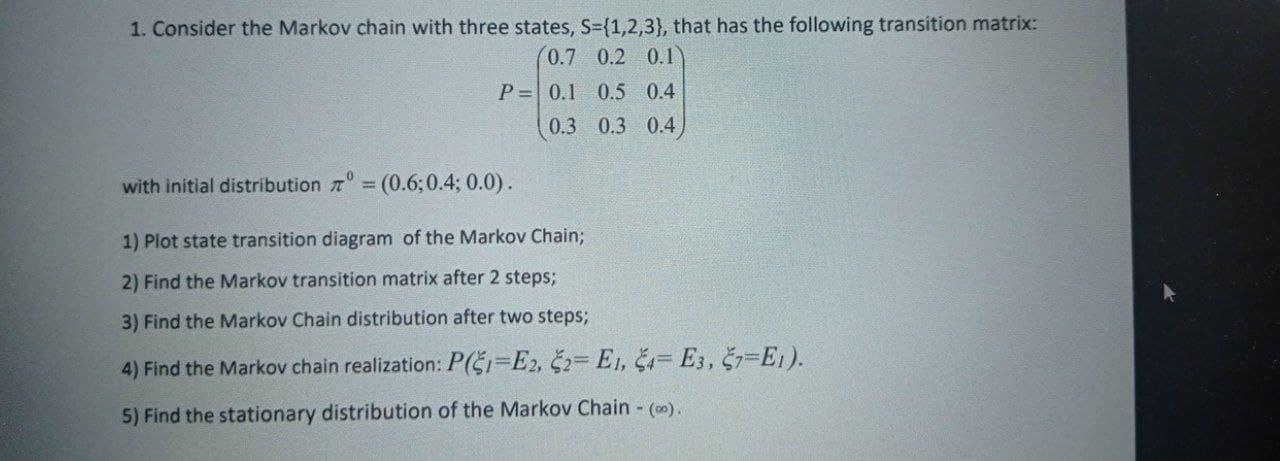
1. Consider the Markov chain with three states, S=(1,2,3), that has the following transition matrix: 0.3 0.4 0.3 P = 0.1 0.3 0.6 0.1 0.2 0.7 with initial distribution mo =(0.2; 0.3; 0.5) . 1) Plot state transition diagram of the Markov Chain; 2) Find the Markov transition matrix after 2 steps; 3) Find the Markov Chain distribution after two steps; 4) Find the Markov chain realization: (X1=1; X2=2; X4=3 ; X7=2) 5) Find the stationary distribution of the Markov Chain - (co).Consider the following Markov chain with the following transition diagram on states {1, 2, 3} al- 2 CO 173 3 (a) Is this Markov chain irreducible? [1 marks] (b) Find the probability of the Markov chain to move to state 3 after two time steps, providing it starts in state 2. [3 marks]Consider a Markov chain {Xn, n = 0, 1, . ..} on the state space S = {0, 1, 2}. Suppose that the Markov chain has the transition matrix 2 10 10 10 2 P = 3 10 2 4 10 10 1. Show that the Markov chain has a unique stationary mass. 2. Let h denote the stationary mass of the Markov chain. Find h(x) for all x E S. 3. Show that the Markov chain has the steady state mass. 4. Let h* denote the steady state mass of the Markov chain. Find h*(x) for all x E S.1. Consider the Markov chain with three states, S=(1,2,3), that has the following transition matrix: 0.7 0.2 0.1 P = 0.1 0.5 0.4 0.3 0.3 0.4 with initial distribution 7 = (0.6;0.4; 0.0). 1) Plot state transition diagram of the Markov Chain; 2) Find the Markov transition matrix after 2 steps; 3) Find the Markov Chain distribution after two steps; 4) Find the Markov chain realization: P($1=E2, 52= El, (4= E3, $7=E1). 5) Find the stationary distribution of the Markov Chain - (co)
Step by Step Solution
There are 3 Steps involved in it

Get step-by-step solutions from verified subject matter experts
 Study Help