







Question: Consider the LTV Vought A - 7 data indicated below for three flight conditions where H denotes altitude and V denotes velocity. ( Introduction to
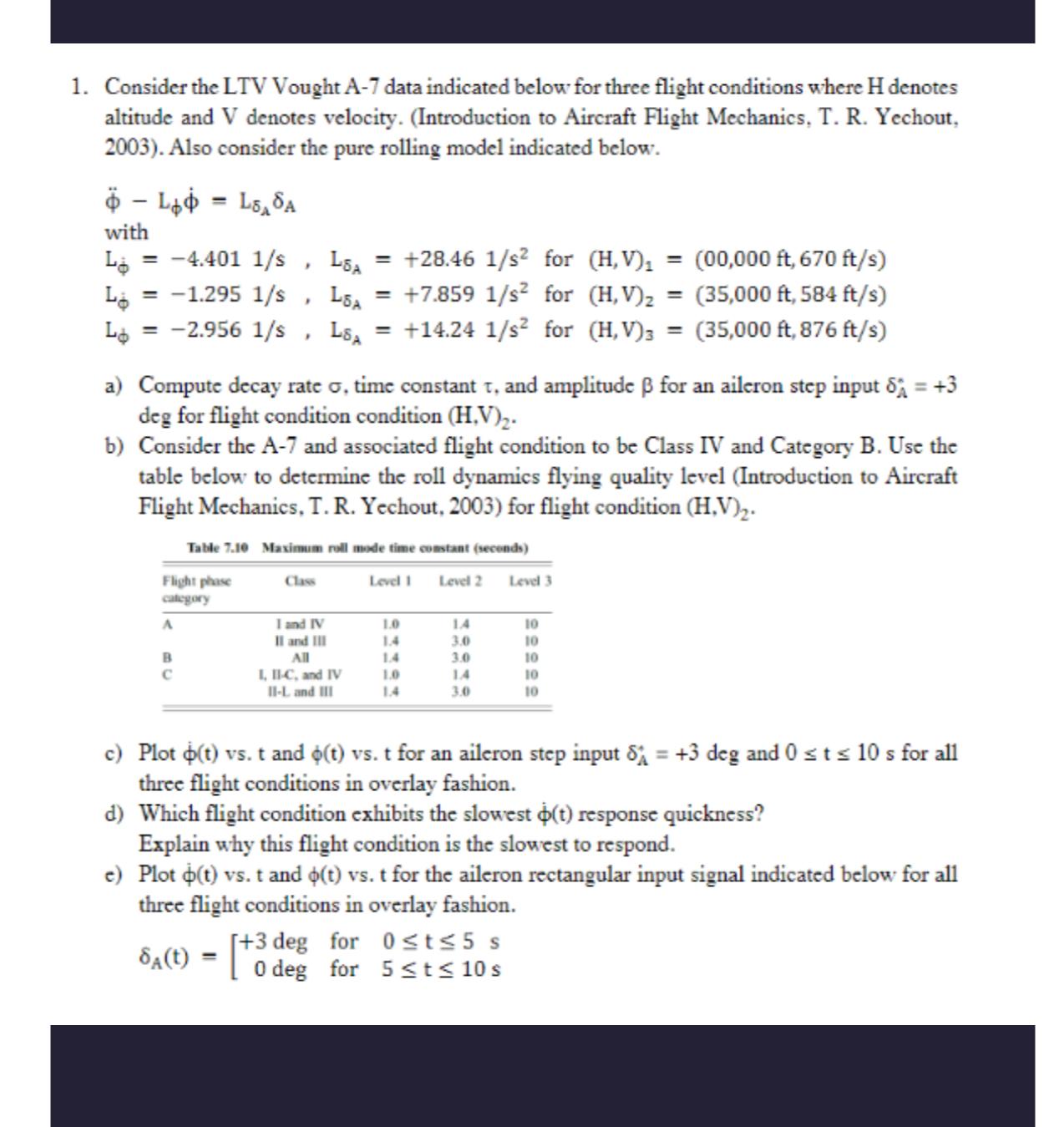
Consider the LTV Vought A data indicated below for three flight conditions where denotes altitude and V denotes velocity. Introduction to Aircraft Flight Mechanics, T R Yechout, Also consider the pure rolling model indicated below.
with
for
for
for
a Compute decay rate time constant and amplitude for an aileron step input deg for flight condition condition
b Consider the A and associated flight condition to be Class IV and Category B Use the table below to determine the roll dynamics flying quality level Introduction to Aircraft Flight Mechanics, T R Yechout, for flight condition
tableTable Maximum roll mode time comstant secendsFlight phase,Class,Levi I,Level Levil categoryAI and IVII and III,BAII,CI, IIC and IVIIL and III,
c Plot vs and vs for an aileron step input deg and s for all three flight conditions in overlay fashion.
d Which flight condition exhibits the slowest response quickness? Explain why this flight condition is the slowest to respond.
e Plot vs and vs for the aileron rectangular input signal indicated below for all three flight conditions in overlay fashion.
Step by Step Solution
There are 3 Steps involved in it
1 Expert Approved Answer
Step: 1 Unlock

Question Has Been Solved by an Expert!
Get step-by-step solutions from verified subject matter experts
Step: 2 Unlock
Step: 3 Unlock
 Study Help