







Question: 1. Consider the LTV Vought A-7 data indicated below for three flight conditions where H denotes altitude and V denotes velocity. (Introduction to Aircraft
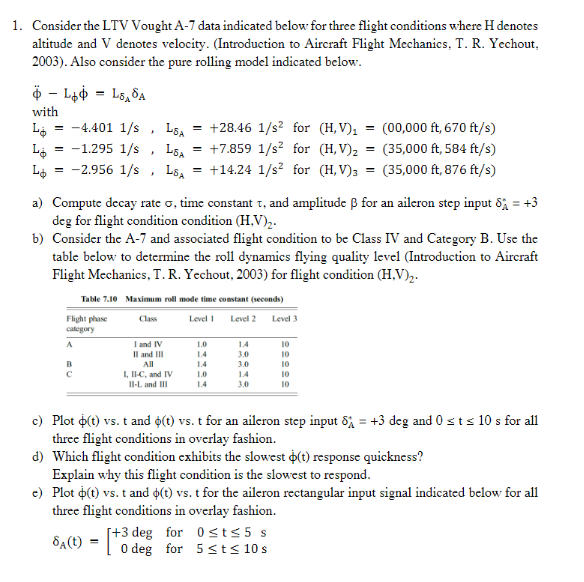
1. Consider the LTV Vought A-7 data indicated below for three flight conditions where H denotes altitude and V denotes velocity. (Introduction to Aircraft Flight Mechanics, T. R. Yechout, 2003). Also consider the pure rolling model indicated below. with - L = L5, SA L = -4.401 1/s = -1.295 1/s L Lo = F -2.956 1/s LSA Flight phase category A B LSA = +28.46 1/s for (H,V) = (00,000 ft, 670 ft/s) LSA = +7.859 1/s for (H,V) = (35,000 ft, 584 ft/s) +14.24 1/s for (H,V)3 = (35,000 ft, 876 ft/s) a) Compute decay rate o, time constant t, and amplitude 3 for an aileron step input 8 = +3 deg for flight condition condition (H.V). b) Consider the A-7 and associated flight condition to be Class IV and Category B. Use the table below to determine the roll dynamics flying quality level (Introduction to Aircraft Flight Mechanics, T. R. Yechout, 2003) for flight condition (H,V) . Table 7.10 Maximum roll mode time constant (seconds) Class Level 1 Level 2 I and IV II and III All = I, II-C, and IV II-L and III 1.0 1.4 1.4 1.0 1.4 14 3.0 3.0 14 3.0 Level 3 10 10 10 10 10 c) Plot (t) vs. t and o(t) vs. t for an aileron step input = +3 deg and 0 t 10 s for all three flight conditions in overlay fashion. d) Which flight condition exhibits the slowest (t) response quickness? +3 for 0t5 s SA(t) = [0 deg for 5 st 10 s Explain why this flight condition is the slowest to respond. e) Plot (t) vs. t and o(t) vs. t for the aileron rectangular input signal indicated below for all three flight conditions in overlay fashion.
Step by Step Solution
There are 3 Steps involved in it

Get step-by-step solutions from verified subject matter experts
 Study Help