Question: Consider the many specific organizational changes discussed in the case (e.g., increased span of control, top-down planning, nonnegotiable budgets, etc.): Which of these changes are
-
Consider the many specific organizational changes discussed in the case (e.g., increased span of control, top-down planning, nonnegotiable budgets, etc.):
-
Which of these changes are likely to be most powerful in shaping organizational
behavior? Why? Write down a list of these changes ordered by likely impact.
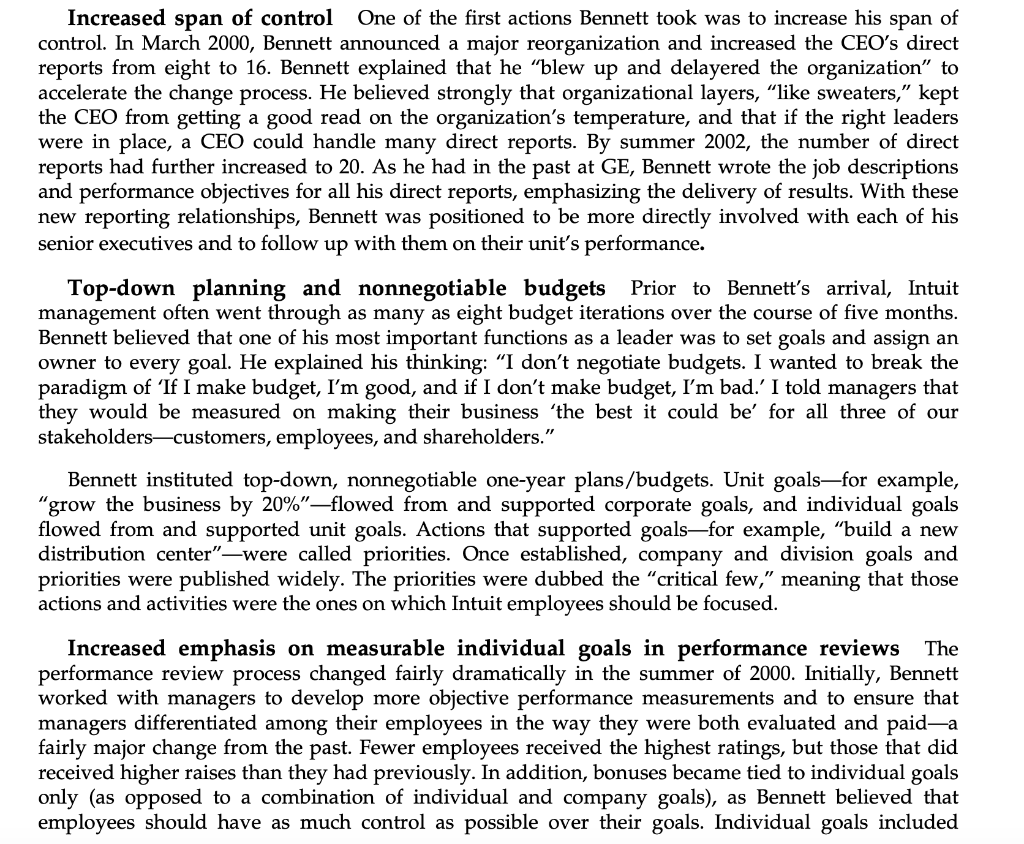
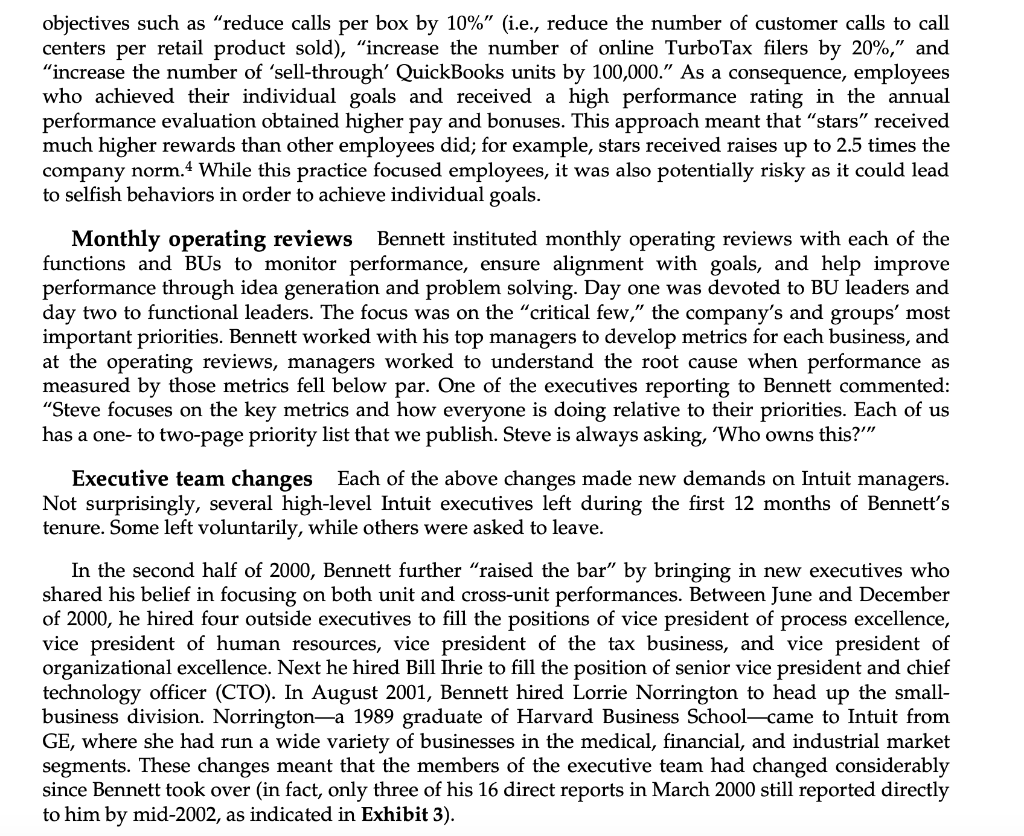
Increased span of control One of the first actions Bennett took was to increase his span of control. In March 2000, Bennett announced a major reorganization and increased the CEO's direct reports from eight to 16. Bennett explained that he blew up and delayered the organization" to accelerate the change process. He believed strongly that organizational layers, like sweaters, kept the CEO from getting a good read on the organization's temperature, and that if the right leaders were in place, a CEO could handle many direct reports. By summer 2002, the number of direct reports had further increased to 20. As he had in the past at GE, Bennett wrote the job descriptions and performance objectives for all his direct reports, emphasizing the delivery of results. With these new reporting relationships, Bennett was positioned to be more directly involved with each of his senior executives and to follow up with them on their unit's performance. Top-down planning and nonnegotiable budgets Prior to Bennett's arrival, Intuit management often went through as many as eight budget iterations over the course of five months. Bennett believed that one of his most important functions as a leader was to set goals and assign an owner to every goal. He explained his thinking: I don't negotiate budgets. I wanted to break the paradigm of 'If I make budget, I'm good, and if I don't make budget, I'm bad.' I told managers that they would be measured on making their business 'the best it could be for all three of our stakeholderscustomers, employees, and shareholders." Bennett instituted top-down, nonnegotiable one-year plans/budgets. Unit goalsfor example, "grow the business by 20%"flowed from and supported corporate goals, and individual goals flowed from and supported unit goals. Actions that supported goalsfor example, "build a new distribution center"-were called priorities. Once established, company and division goals and priorities were published widely. The priorities were dubbed the "critical few," meaning that those actions and activities were the ones on which Intuit employees should be focused. Increased emphasis on measurable individual goals in performance reviews The performance review process changed fairly dramatically in the summer of 2000. Initially, Bennett worked with managers to develop more objective performance measurements and to ensure that managers differentiated among their employees in the way they were both evaluated and paid-a fairly major change from the past. Fewer employees received the highest ratings, but those that did received higher raises than they had previously. In addition, bonuses became tied to individual goals only (as opposed to a combination of individual and company goals), as Bennett believed that employees should have as much control as possible over their goals. Individual goals included objectives such as reduce calls per box by 10%" (i.e., reduce the number of customer calls to call centers per retail product sold), increase the number of online TurboTax filers by 20%," and "increase the number of 'sell-through' QuickBooks units by 100,000. As a consequence, employees who achieved their individual goals and received a high performance rating in the annual performance evaluation obtained higher pay and bonuses. This approach meant that stars received much higher rewards than other employees did; for example, stars received raises up to 2.5 times the company norm.4 While this practice focused employees, it was also potentially risky as it could lead to selfish behaviors in order to achieve individual goals. Monthly operating reviews Bennett instituted monthly operating reviews with each of the functions and Bus to monitor performance, ensure alignment with goals, and help improve performance through idea generation and problem solving. Day one was devoted to BU leaders and day two to functional leaders. The focus was on the "critical few," the company's and groups' most important priorities. Bennett worked with his top managers to develop metrics for each business, and at the operating reviews, managers worked to understand the root cause when performance as measured by those metrics fell below par. One of the executives reporting to Bennett commented: Steve focuses on the key metrics and how everyone is doing relative to their priorities. Each of us has a one-to two-page priority list that we publish. Steve is always asking, 'Who owns this?"" Executive team changes Each of the above changes made new demands on Intuit managers. Not surprisingly, several high-level Intuit executives left during the first 12 months of Bennett's tenure. Some left voluntarily, while others were asked to leave. In the second half of 2000, Bennett further raised the bar by bringing in new executives who shared his belief in focusing on both unit and cross-unit performances. Between June and December of 2000, he hired four outside executives to fill the positions of vice president of process excellence, vice president of human resources, vice president of the tax business, and vice president of organizational excellence. Next he hired Bill Ihrie to fill the position of senior vice president and chief technology officer (CTO). In August 2001, Bennett hired Lorrie Norrington to head up the small- business division. Norringtona 1989 graduate of Harvard Business School-came to Intuit from GE, where she had run a wide variety of businesses in the medical, financial, and industrial market segments. These changes meant that the members of the executive team had changed considerably since Bennett took over (in fact, only three of his 16 direct reports in March 2000 still reported directly to him by mid-2002, as indicated in Exhibit 3)









 Study Help