







Question: Consider the mode method, which is intended to retum the most frequently occurring valse (mode) in its int[] parmeter arr. For eximple, if the parameter
![frequently occurring valse (mode) in its int[] parmeter arr. For eximple, if](https://dsd5zvtm8ll6.cloudfront.net/si.experts.images/questions/2024/09/66f3e78fa09f6_55966f3e78f3c57d.jpg)
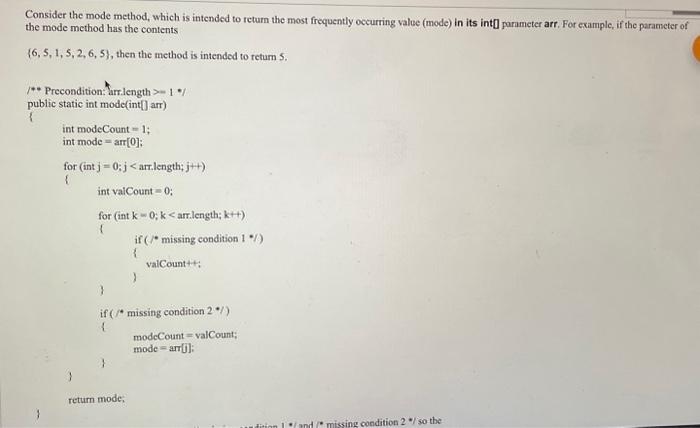
Consider the mode method, which is intended to retum the most frequently occurring valse (mode) in its int[] parmeter arr. For eximple, if the parameter of the mode method has the contents {6,5,1,5,2,6,5}, then the method is intended to retum 5 . 1** Precondition: arr.length >=1 public static int mode(int[] arr) Which of the following can replace / missing condition 1/ and / missing condition 2/ so the code segment works as intended? /missingcondition1/arr[j]!=arr[k]/missingcondition2/modeCount!=valCount /missingcondition1/arr[j]]=arr[k]/missingcondition2/modeCount>valCount /missingcondition1/arr[j]!=arr[k]/missingcondition2/valCount>modeCount /missingcondition1//missingcondition2arr[j]=arr[k]modeCount>valCount/missingcondition1//missingcondition2arr[j]=arr[k]valCount>modeCount Consider the mode method, which is intended to retum the most frequently occurring valse (mode) in its int[] parmeter arr. For eximple, if the parameter of the mode method has the contents {6,5,1,5,2,6,5}, then the method is intended to retum 5 . 1** Precondition: arr.length >=1 public static int mode(int[] arr) Which of the following can replace / missing condition 1/ and / missing condition 2/ so the code segment works as intended? /missingcondition1/arr[j]!=arr[k]/missingcondition2/modeCount!=valCount /missingcondition1/arr[j]]=arr[k]/missingcondition2/modeCount>valCount /missingcondition1/arr[j]!=arr[k]/missingcondition2/valCount>modeCount /missingcondition1//missingcondition2arr[j]=arr[k]modeCount>valCount/missingcondition1//missingcondition2arr[j]=arr[k]valCount>modeCount
Step by Step Solution
There are 3 Steps involved in it

Get step-by-step solutions from verified subject matter experts
 Study Help