







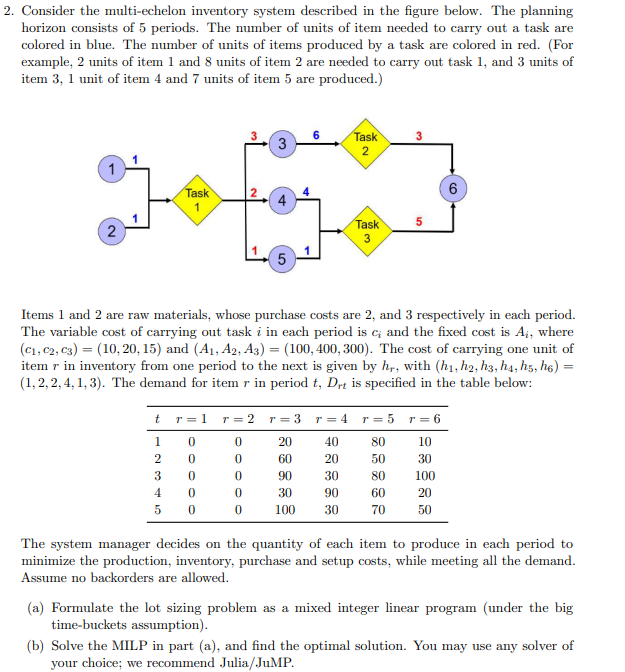
Question: Consider the multi - echelon inventory system described in the figure below. The planning horizon consists of 5 periods. The number of units of item
Consider the multiechelon inventory system described in the figure below. The planning
horizon consists of periods. The number of units of item needed to carry out a task are
colored in blue. The number of units of items produced by a task are colored in red. For
example, units of item and units of item are needed to carry out task and units of
item unit of item and units of item are produced.
Items and are raw materials, whose purchase costs are and respectively in each period.
The variable cost of carrying out task in each period is and the fixed cost is where
and The cost of carrying one unit of
item in inventory from one period to the next is given by with
The demand for item in period is specified in the table below:
The system manager decides on the quantity of each item to produce in each period to
minimize the production, inventory, purchase and setup costs, while meeting all the demand.
Assume no backorders are allowed.
a Formulate the lot sizing problem as a mixed integer linear program under the big
timebuckets assumption
b Solve the MILP in part a and find the optimal solution. You may use any solver of
your choice; we recommend JuliaJuMP
Step by Step Solution
There are 3 Steps involved in it
1 Expert Approved Answer
Step: 1 Unlock

Question Has Been Solved by an Expert!
Get step-by-step solutions from verified subject matter experts
Step: 2 Unlock
Step: 3 Unlock
 Study Help