







Question: Consider the network fragment shown below. x X W x Y X has only two attached neighbours, W and Y, with link costs as
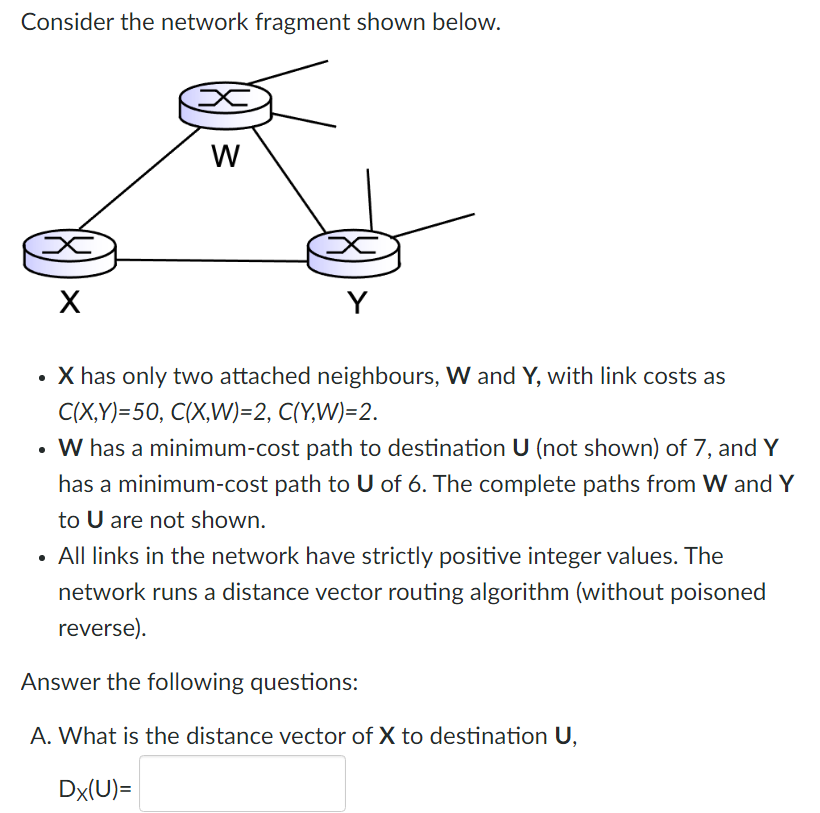
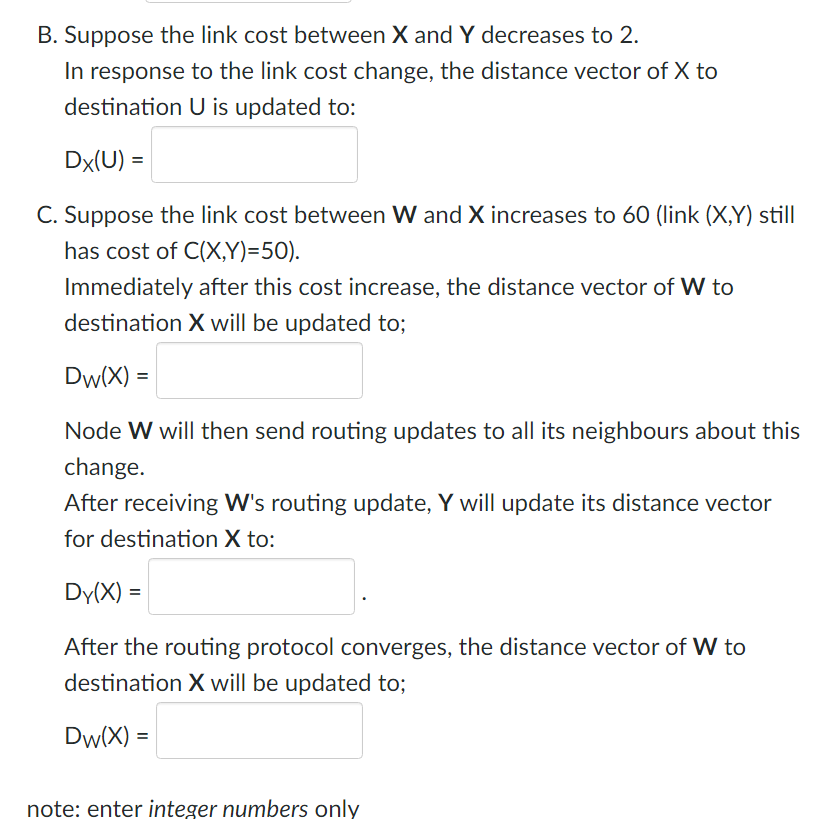
Consider the network fragment shown below. x X W x Y X has only two attached neighbours, W and Y, with link costs as C(X,Y)=50, C(X,W)=2, C(Y,W)=2. W has a minimum-cost path to destination U (not shown) of 7, and Y has a minimum-cost path to U of 6. The complete paths from W and Y to U are not shown. All links in the network have strictly positive integer values. The network runs a distance vector routing algorithm (without poisoned reverse). Answer the following questions: A. What is the distance vector of X to destination U, Dx(U)= B. Suppose the link cost between X and Y decreases to 2. In response to the link cost change, the distance vector of X to destination U is updated to: Dx(U) = C. Suppose the link cost between W and X increases to 60 (link (X,Y) still has cost of C(X,Y)=50). Immediately after this cost increase, the distance vector of W to destination X will be updated to; Dw(X) = Node W will then send routing updates to all its neighbours about this change. After receiving W's routing update, Y will update its distance vector for destination X to: Dy(X) = After the routing protocol converges, the distance vector of W to destination X will be updated to; Dw(X) = note: enter integer numbers only
Step by Step Solution
There are 3 Steps involved in it

Get step-by-step solutions from verified subject matter experts
 Study Help