







Question: Consider the network (G, w) with VG) = {a,b, c, d, e, f}, E(G) = {ab, ac, ad, ae, af, bc, bd, be, bf, cd,
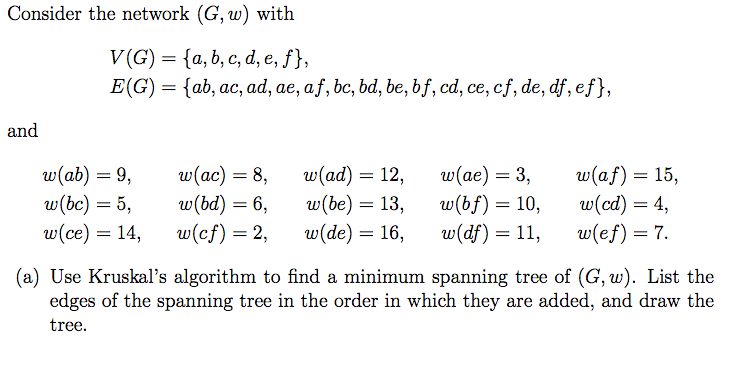

Consider the network (G, w) with VG) = {a,b, c, d, e, f}, E(G) = {ab, ac, ad, ae, af, bc, bd, be, bf, cd, ce, cf, de, df, ef}, and w(ab) = 9, w(ac) = 8, w(ad) = 12, wae) = 3, w(af) = 15, w(bc) = 5, wbd) = 6, w(be) = 13, w(bf) = 10, w(cd) = 4, w(ce) = 14, w(cf) = 2, w(de) = 16, w(df) = 11, w(ef) = 7. (a) Use Kruskal's algorithm to find a minimum spanning tree of (G, w). List the edges of the spanning tree in the order in which they are added, and draw the tree. (b) Use the reverse-delete algorithm to find a minimum spanning tree of (G,w). List the edges not in the spanning tree in the order in which they are removed. (c) Use Exercise 1 to show that the minimum spanning tree found by both algo- rithms is in fact the unique minimum spanning tree of (G,w)
Step by Step Solution
There are 3 Steps involved in it

Get step-by-step solutions from verified subject matter experts
 Study Help