







Question: Consider the orthogonal distance regression ( ODR ) problem, which can be stated as follows. Given N random observations ( x i , Y i
Consider the orthogonal distance regression ODR problem, which can be stated as follows. Given random observations of the true underlying data which follow the relationship for dots, We would like to find such that the total squared distance between and is minimized, ie
This is an unconstrained optimisation problem which can be solved by a trustregion algorithm described as follows.
Choose initial point initial radius maximum radius and threshold while do
Calculate by solving the following problem
gradf
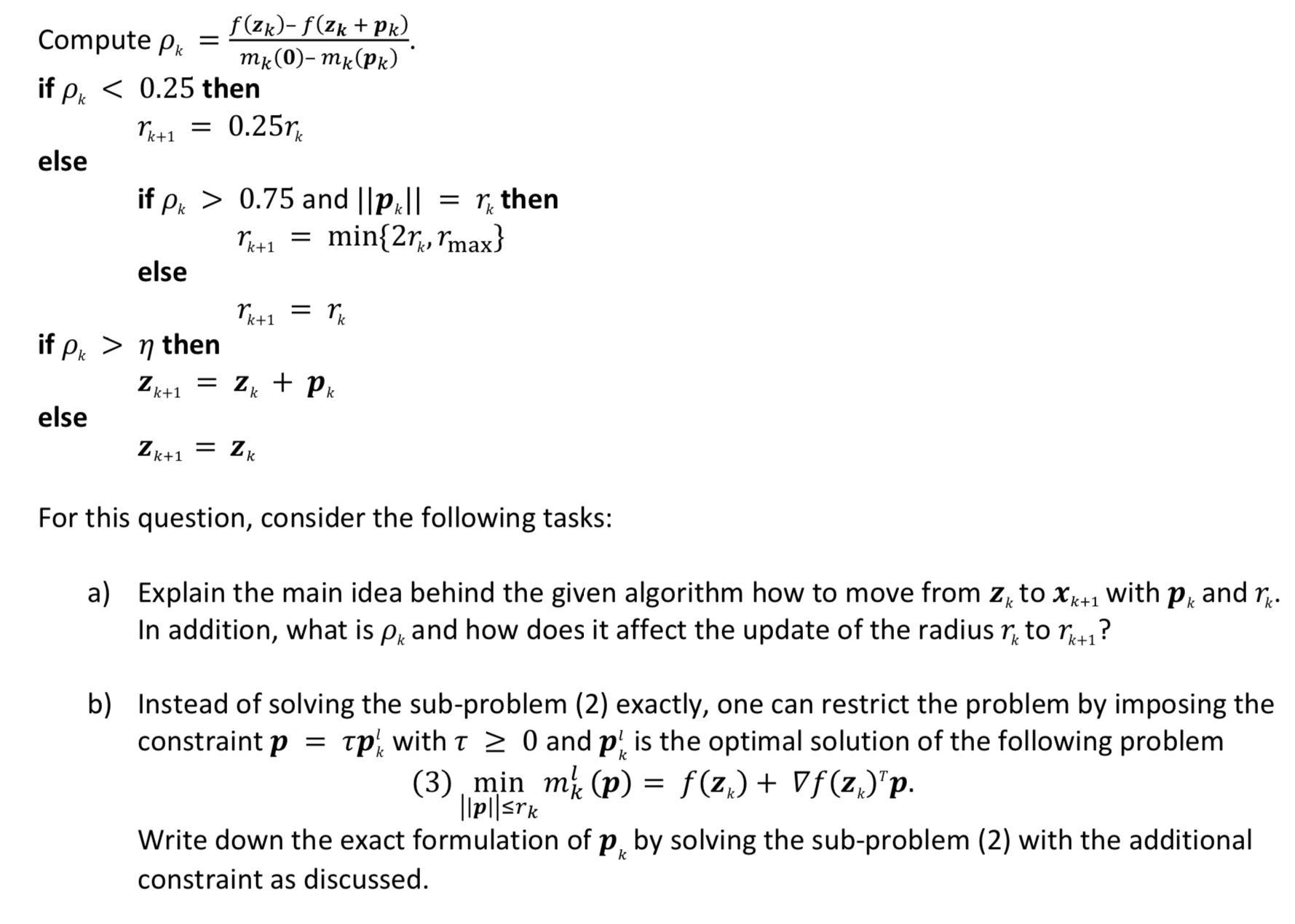
Compute
if then
else
if and then
else
min
if then
else
For this question, consider the following tasks:
a Explain the main idea behind the given algorithm how to move from to with and In addition, what is and how does it affect the update of the radius to
b Instead of solving the subproblem exactly, one can restrict the problem by imposing the constraint with and is the optimal solution of the following problem
gradf
Write down the exact formulation of by solving the subproblem with the additional constraint as discussed.
Step by Step Solution
There are 3 Steps involved in it
1 Expert Approved Answer
Step: 1 Unlock

Question Has Been Solved by an Expert!
Get step-by-step solutions from verified subject matter experts
Step: 2 Unlock
Step: 3 Unlock
 Study Help