







Question: Consider the problem of multiplying two 4-bit unsigned integers, X-11 and Y-5, to find the product X*Y- 55. The process is outlined below: 1011 x
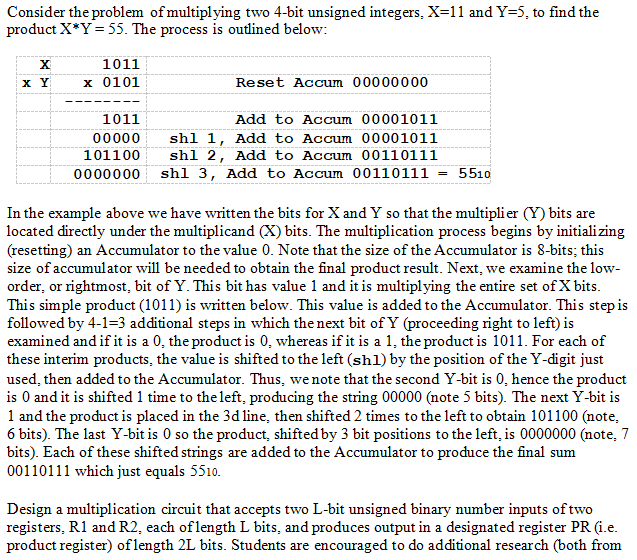
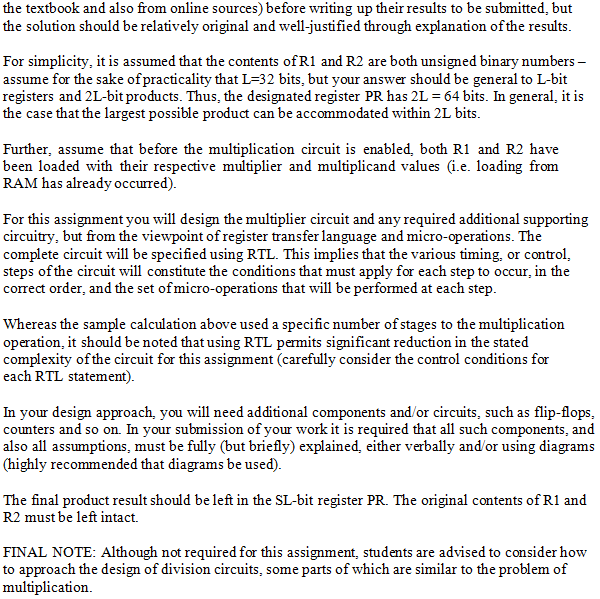
Consider the problem of multiplying two 4-bit unsigned integers, X-11 and Y-5, to find the product X*Y- 55. The process is outlined below: 1011 x 0101 Reset Accum 00000000 1011 Add to Accum 00001011 00000 shl 1, Add to Accum 00001011 101100shl 2, Add to Accum 00110111 0000000 shl 3, Add to Accum 00110111 - 5510 In the example above we have written the bits for X and Y so that the multipli er (Y) bits are located directly under the multiplicand (X) bits. The multiplication process begins by initiali zing (resetting) an Accumulator to the value 0. Note that the size of the Accumulator is 8-bits; this size of accumulator will be needed to obtain the final product result. Next, we examine the low- order, or rightmost, bit of Y. This bit has value 1 and it is multiplying the entire set of X bits This simple product (1011) is written below. This value is added to the Accumulator. This step is followed by 4-1-3 additional steps in which the next bit of Y (proceeding right to left) is examined and if it is a 0, the product is 0, whereas if it is a 1, the product is 1011. For each of these interim products, the value is shifted to the left (shl)by the position of the Y-digit just used, then added to the Accumulator. Thus, we note that the second Y-bit is 0, hence the product is 0 and it is shifted 1 time to the left, producing the string 00000 (note 5 bits). The next Y-bit is 1 and the product is placed in the 3d line, then shifted 2 times to the left to obtain 101100 (note, 6 bits). The last Y-bit is 0 so the product, shifted by 3 bit positions to the left, is 0000000 (note,7 bits). Each of these shifted strings are added to the Accumulator to produce the final sum 00110111 which just equals 5510. Design a multiplication circuit that accepts two L-bit unsigned binary number inputs of two registers, R1 and R2, each oflength L bits, and produces output in a designated register PR(i.e product register) of length 2L bits. Students are encouraged to do additional research (both from Consider the problem of multiplying two 4-bit unsigned integers, X-11 and Y-5, to find the product X*Y- 55. The process is outlined below: 1011 x 0101 Reset Accum 00000000 1011 Add to Accum 00001011 00000 shl 1, Add to Accum 00001011 101100shl 2, Add to Accum 00110111 0000000 shl 3, Add to Accum 00110111 - 5510 In the example above we have written the bits for X and Y so that the multipli er (Y) bits are located directly under the multiplicand (X) bits. The multiplication process begins by initiali zing (resetting) an Accumulator to the value 0. Note that the size of the Accumulator is 8-bits; this size of accumulator will be needed to obtain the final product result. Next, we examine the low- order, or rightmost, bit of Y. This bit has value 1 and it is multiplying the entire set of X bits This simple product (1011) is written below. This value is added to the Accumulator. This step is followed by 4-1-3 additional steps in which the next bit of Y (proceeding right to left) is examined and if it is a 0, the product is 0, whereas if it is a 1, the product is 1011. For each of these interim products, the value is shifted to the left (shl)by the position of the Y-digit just used, then added to the Accumulator. Thus, we note that the second Y-bit is 0, hence the product is 0 and it is shifted 1 time to the left, producing the string 00000 (note 5 bits). The next Y-bit is 1 and the product is placed in the 3d line, then shifted 2 times to the left to obtain 101100 (note, 6 bits). The last Y-bit is 0 so the product, shifted by 3 bit positions to the left, is 0000000 (note,7 bits). Each of these shifted strings are added to the Accumulator to produce the final sum 00110111 which just equals 5510. Design a multiplication circuit that accepts two L-bit unsigned binary number inputs of two registers, R1 and R2, each oflength L bits, and produces output in a designated register PR(i.e product register) of length 2L bits. Students are encouraged to do additional research (both from
Step by Step Solution
There are 3 Steps involved in it

Get step-by-step solutions from verified subject matter experts
 Study Help