







Question: Consider the same sampled-data robot arm control system in Problem #1. (a) Let theta (t) and theta (t) be the state variables and find the
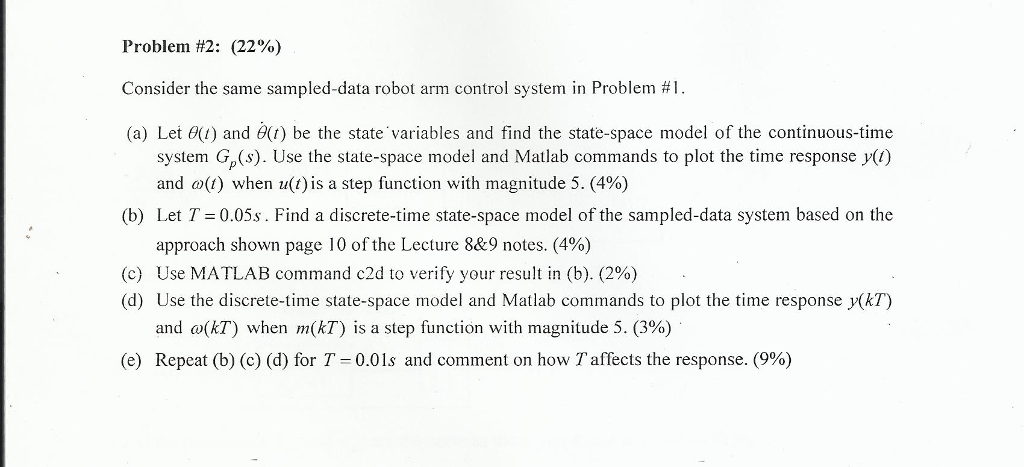
Consider the same sampled-data robot arm control system in Problem #1. (a) Let theta (t) and theta (t) be the state variables and find the state-space model of the continuous-time system G_p(s). Use the state-space model and Matlab commands to plot the time response y(t) and omega (t) when u(t) is a step function with magnitude 5. (4%) (b) Let T = 0.05s. Find a discrete-time state-space model of the sampled-data system based on the approach shown page 10 of the Lecture 8 & 9 notes. (4%) (c) Use MATLAB command c2d to verify your result in (b). (2%) (d) Use the discrete-time state-space model and Matlab commands to plot the time response y(kT) and omega (kT) when m(kT) is a step function with magnitude 5. (3%) (e) Repeat (b) (c) (d) for T = 0.01s and comment on how T affects the response. (9%) Consider the same sampled-data robot arm control system in Problem #1. (a) Let theta (t) and theta (t) be the state variables and find the state-space model of the continuous-time system G_p(s). Use the state-space model and Matlab commands to plot the time response y(t) and omega (t) when u(t) is a step function with magnitude 5. (4%) (b) Let T = 0.05s. Find a discrete-time state-space model of the sampled-data system based on the approach shown page 10 of the Lecture 8 & 9 notes. (4%) (c) Use MATLAB command c2d to verify your result in (b). (2%) (d) Use the discrete-time state-space model and Matlab commands to plot the time response y(kT) and omega (kT) when m(kT) is a step function with magnitude 5. (3%) (e) Repeat (b) (c) (d) for T = 0.01s and comment on how T affects the response. (9%)
Step by Step Solution
There are 3 Steps involved in it

Get step-by-step solutions from verified subject matter experts
 Study Help