







Question: Consider the spectrometer shown below. Do the ions with the trajectory shown by the blue arrows have a positive or negative charge? For a mass
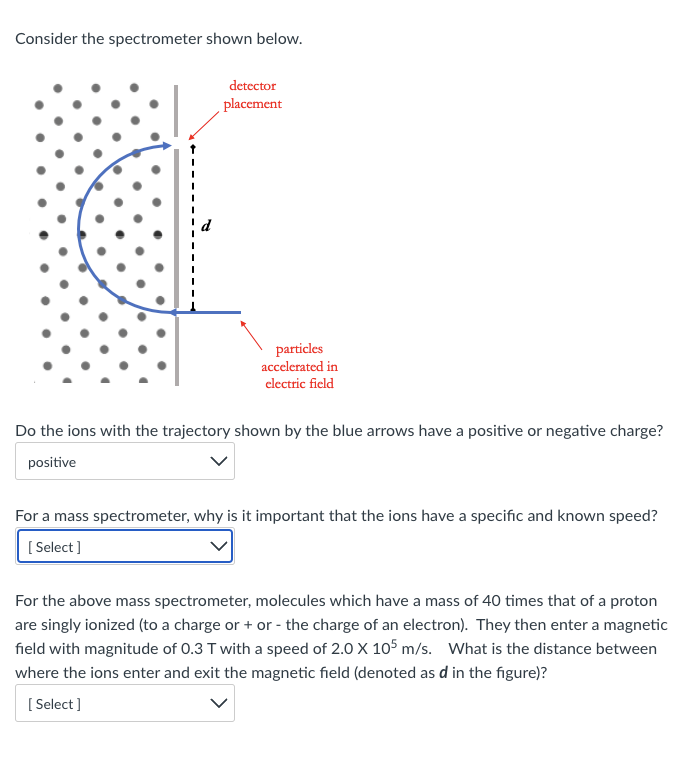
Consider the spectrometer shown below.
Do the ions with the trajectory shown by the blue arrows have a positive or negative charge?
For a mass spectrometer, why is it important that the ions have a specific and known speed?
For the above mass spectrometer, molecules which have a mass of times that of a proton are singly ionized to a charge or or the charge of an electron They then enter a magnetic field with magnitude of T with a speed of times mathrm~mmathrms What is the distance between where the ions enter and exit the magnetic field denoted as boldsymbold in the figure
Select
If the ions are moving too fast, the magnetic field will not be able to bend their path to the detector.
The ions are all accelerated by the same electric field, and so will all have the same speed anyway.
The orbit must be circular, and this is the case only for a certain range of speeds.
The radius of the orbit depends on the mass, the charge and the speed. If the charge and the speed are the same, the orbit depends only on the mass. Consider the spectrometer shown below.
Do the ions with the trajectory shown by the blue arrows have a positive or negative charge?
For a mass spectrometer, why is it important that the ions have a specific and known speed?
For the above mass spectrometer, molecules which have a mass of times that of a proton are singly ionized to a charge or or the charge of an electron They then enter a magnetic field with magnitude of T with a speed of times mathrm~mmathrms What is the distance between where the ions enter and exit the magnetic field denoted as boldsymbold in the figure
Select
If the ions are moving too fast, the magnetic field will not be able to bend their path to the detector.
The ions are all accelerated by the same electric field, and so will all have the same speed anyway.
The orbit must be circular, and this is the case only for a certain range of speeds.
The radius of the orbit depends on the mass, the charge and the speed. If the charge and the speed are the same, the orbit depends only on the mass. Select
m
m
m
m
m
cm
cm
m
Step by Step Solution
There are 3 Steps involved in it
1 Expert Approved Answer
Step: 1 Unlock

Question Has Been Solved by an Expert!
Get step-by-step solutions from verified subject matter experts
Step: 2 Unlock
Step: 3 Unlock
 Study Help