







Question: Consider the traditional k-means clustering algorithm and let d(a,, a, ) be squared Euclidean distance. Prove the following identity: C()= CQ)=0 C(i)=k More specifically, prove
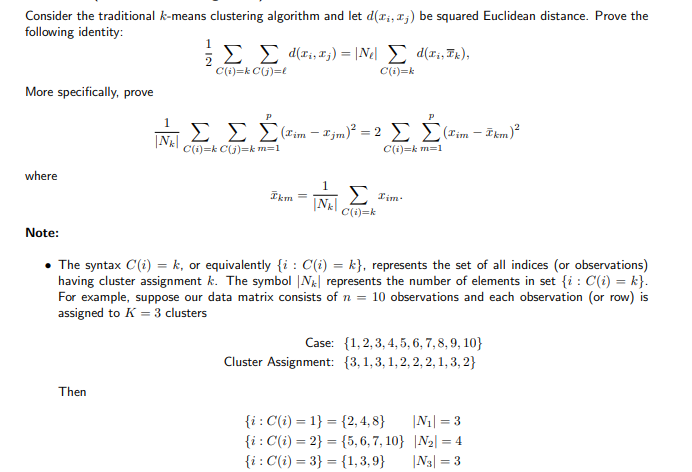
Consider the traditional k-means clustering algorithm and let d(a,, a, ) be squared Euclidean distance. Prove the following identity: C()= CQ)=0 C(i)=k More specifically, prove 1 Nal E EE(Jim - Ijm) =2 _ _ (Iim - Ikm)? C(i)=k C(j)=km=1 C(i)=km=1 where Ckm 1 Tim. C()=k Note: . The syntax C(i) = k, or equivalently {i : C() = k}, represents the set of all indices (or observations) having cluster assignment k. The symbol |NV,| represents the number of elements in set {i : C(i) = k}. For example, suppose our data matrix consists of n = 10 observations and each observation (or row) is assigned to K = 3 clusters Case: {1, 2, 3, 4, 5, 6, 7, 8, 9, 10} Cluster Assignment: {3, 1, 3, 1, 2, 2, 2, 1, 3, 2} Then {i : C(i) = 1} = (2, 4,8} |Nil = 3 {i : C(i) = 2} = (5,6, 7, 10} [N2) = 4 {i : C(i) = 3} = {1,3,9} INal = 3
Step by Step Solution
There are 3 Steps involved in it

Get step-by-step solutions from verified subject matter experts
 Study Help