







Question: Consider the two scenarios shown below for a simple HTTP request. (15) Authoritative DNS server HTTP server TLD DNS server HTTP server RTT auth RTT
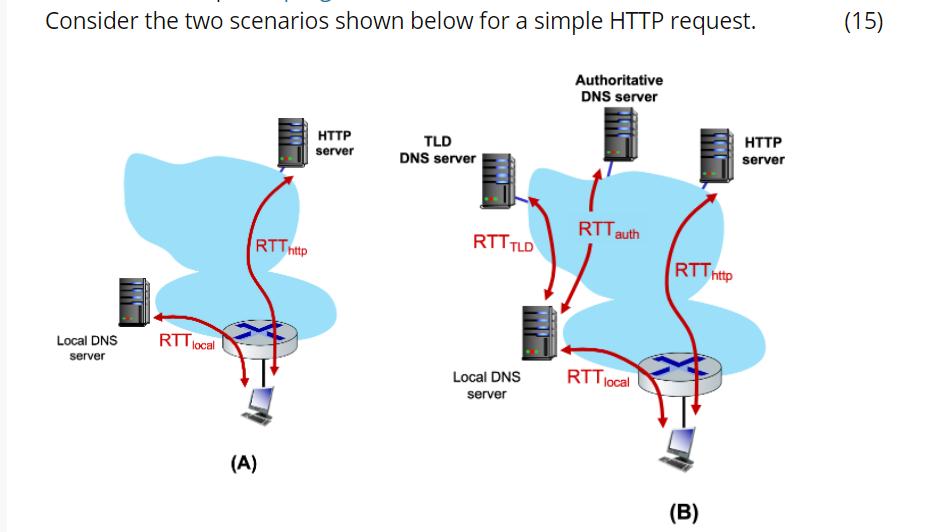
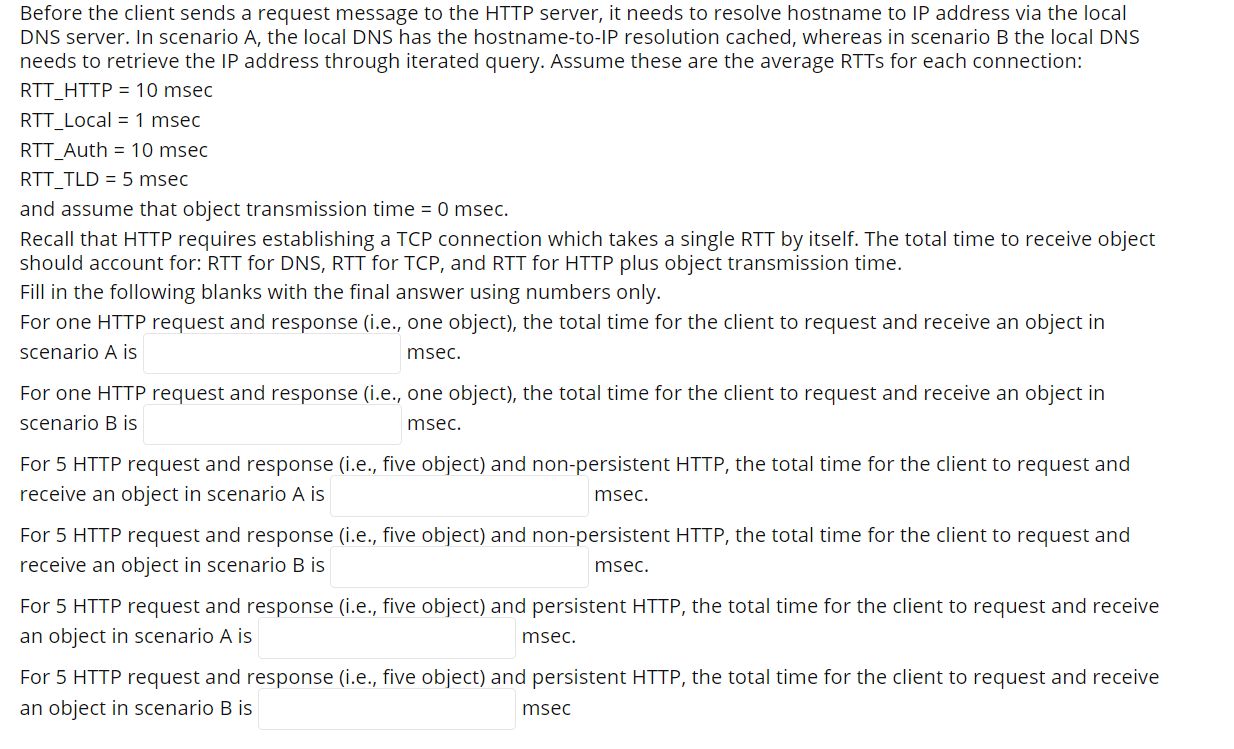
Consider the two scenarios shown below for a simple HTTP request. (15) Authoritative DNS server HTTP server TLD DNS server HTTP server RTT auth RTT http RTTTLD RTT http Local DNS server RTT local Local DNS server RTTlocal (A) (B) Before the client sends a request message to the HTTP server, it needs to resolve hostname to IP address via the local DNS server. In scenario A, the local DNS has the hostname-to-IP resolution cached, whereas in scenario B the local DNS needs to retrieve the IP address through iterated query. Assume these are the average RTTs for each connection: RTT_HTTP = 10 msec RTT_Local = 1 msec RTT_Auth = 10 msec RTT_TLD = 5 msec and assume that object transmission time = 0 msec. Recall that HTTP requires establishing a TCP connection which takes a single RTT by itself. The total time to receive object should account for: RTT for DNS, RTT for TCP, and RTT for HTTP plus object transmission time. Fill in the following blanks with the final answer using numbers only. For one HTTP request and response (i.e., one object), the total time for the client to request and receive an object in scenario A is msec. For one HTTP request and response (i.e., one object), the total time for the client to request and receive an object in scenario B is msec. For 5 HTTP request and response (i.e., five object) and non-persistent HTTP, the total time for the client to request and receive an object in scenario A is msec. msec. For 5 HTTP request and response (i.e., five object) and non-persistent HTTP, the total time for the client to request and receive an object in scenario B is For 5 HTTP request and response (i.e., five object) and persistent HTTP, the total time for the client to request and receive an object in scenario A is msec. For 5 HTTP request and response (i.e., five object) and persistent HTTP, the total time for the client to request and receive an object in scenario B is msec
Step by Step Solution
There are 3 Steps involved in it

Get step-by-step solutions from verified subject matter experts
 Study Help